Encyclopedia entry
Cavum Septi Pellucidi
Abstract
The septum pellucidum normally has a cavity of 1 to 2mm in width. When this cavity is larger, it is called cavum septi pellucidi or fifth ventricle. The term fifth ventricle is a misnomer because unlike ventricular cavities it does not contain cerebrospinal fluid nor is it lined by ependyma. The incidence of cavum septi pellucidi was 20.3% in 1032 brains studied. The cavurn septi pellucidi varies from 2 to 95% depending to author; it is more prevalent in the young (infants) than older adults. The extreme differences in the reported frequency is highly suspect.
The septum pellucidum normally has a cavity of 1 to 2mm in width. When this cavity is larger, it is called cavum septi pellucidi or fifth ventricle. The term fifth ventricle is a misnomer because unlike ventricular cavities it does not contain cerebrospinal fluid nor is it lined by ependyma. The incidence of cavum septi pellucidi was 20.3% in 1032 brains studied.
The cavurn septi pellucidi varies from 2 to 95% depending to author; it is more prevalent in the young (infants) than older adults. The extreme differences in the reported frequency is highly suspect.
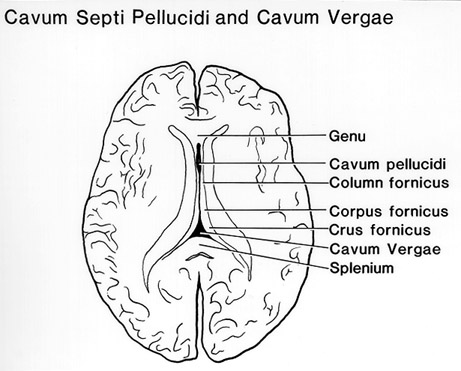
Anatomy Atlases. Image hosted by the site it comes from. Open the original page.
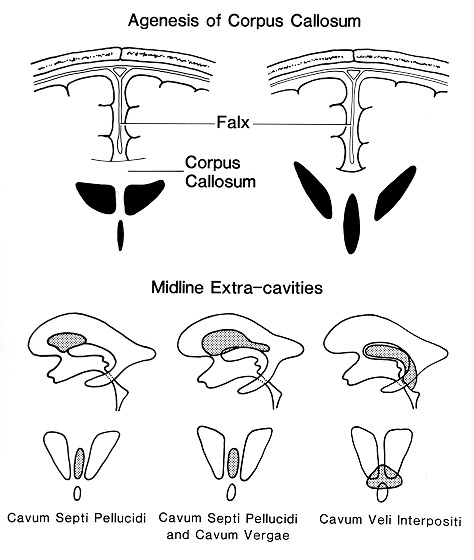
Anatomy Atlases. Image hosted by the site it comes from. Open the original page.
Riferimenti dell’opera originale
Elenco riportato come compare nella fonte, senza normalizzazione dei formati bibliografici.
- Dandy, W.E. (1931) Congenital cerebral cysts of the cavum septi pellucidi (fifth ventricle) and cavum vergae (sixth ventricle). Arch. Neurol. Psychiatry 25:44-66.
- Lang, J. (1983) Clinical Anatomy of the Head. Neurocraniurn, Orbit, Craniocervical Regions. Springer Verlag, Berlin, Heidelberg. New York.
- Mori, K. (1985) Anomalies of the Central Nervous System. Neurology and Neurosurgery. Thieme-Stratton, Inc., New York.
- Schwidde, J.T. (1952) Incidence of cavum septi pellucidi and cavum vergae in 1032 human brains. Arch. Neurol. Psychiatry 67:625-632.
- Thompson, I. M. (1932) On the cavum septi pellucidi. J. Anat. 67:59-77.
Anatomical classification
- Systems:
- Nervous system
Content provenance
Adaptation
Adaptation of «Cavum Septi Pellucidi — Illustrated Encyclopedia of Human Anatomic Variation: Opus I: Muscular System» by Ronald A. Bergman, Adel K. Afifi, Ryosuke Miyauchi. Source: https://www.anatomyatlases.org/AnatomicVariants/NervousSystem/Text/CavumSeptiPellucidi.shtml Original work distributed under the CC BY-NC-SA 4.0 licence (https://creativecommons.org/licenses/by-nc-sa/4.0/deed.it). Adaptation by Redazione AIVA. Changes from the original: Testo originale inglese riprodotto integralmente e riorganizzato nel formato scheda del portale (sintesi, testo, riferimenti), senza modificarne le affermazioni. La traduzione italiana non è ancora stata eseguita, e la pagina lo dichiara. Le figure non sono state copiate: sono collegate alla pagina d’origine. This publication is not approved or endorsed by the authors of the original work.
Licence
This content is distributed under the licence CC BY-NC-SA 4.0. Licences and attribution