Encyclopedia entry
Flexor Carpi Radialis
Abstract
At its origin, the flexor carpi radialis has been observed to receive an additional slip from the tendon of insertion of the biceps or its tendinous expansion, brachialis, the coronoid process of the ulna (~5%), or from the anterior oblique line of the radius. Its insertion is subject to frequent variations, the most common being partial or total attachment to the trapezium. It may also be partly inserted into the flexor retinaculum or navicular (scaphoid) bone, and a supplementary slip to the third metacarpal may be extended to the fourth.
At its origin, the flexor carpi radialis has been observed to receive an additional slip from the tendon of insertion of the biceps or its tendinous expansion, brachialis, the coronoid process of the ulna (~5%), or from the anterior oblique line of the radius. Its insertion is subject to frequent variations, the most common being partial or total attachment to the trapezium. It may also be partly inserted into the flexor retinaculum or navicular (scaphoid) bone, and a supplementary slip to the third metacarpal may be extended to the fourth. In Mori's cases, the terminal tendon is inserted into the second metacarpal in 90%, the terminal tendon sends a slip to the third metacarpal in 7.5%, and it was absent in 2.5%.
Macalister reported the following variations for this muscle: 1. With a triple origin, one head from a slip of the biceps tendon and from the deep surface of the semilunar fascia (this head is separated from the second or usual head by the median nerve), and the third head was from the ulna, below the coronoid process, and this was likewise separated from the foregoing by the same nerve; 2. With the radial head of this muscle joined to the radial origin of the flexor sublimis; 3. With a coronoid head in a case in which the pronator teres had no such slip; 4. And, as described under the foregoing muscle, in one instance these two had a coronoid head in common; in both these cases (3 and 4), the coronoid was separated from the condyloid origin by the median nerve, and in the former case by the brachial artery, in another example of No.3, which occurred to Macalister in 1868, the nerve alone separated the parts; 5. A case of second head, from a special slip of the biceps tendon (Kelly); 6. It has been found inserted in whole or in part into the trapezium by Albinus, Fleishmann, Loschge, Hyrtl, Wood, Theile, Henle, and Macalister; 7. Into the annular ligament and scaphoid by Fleishmann; 8.Into the bases of the third and fourth metacarpals; 9. Into the lower end of the radius, in a case of a congenital deformity by Koster (1856); 10. Into the scapho-trapezium bone, in a case in which only a thumb and two fingers were present, by Friedlowsky, 1869.
Flexor carpi radialis brevis, a small muscle arising from the radius, usually inserts on the fibrous sheath of the tendon of flexor carpi radialis and terminates distally onto the base of the second or third metacarpal. It has been implicated in anterior interosseous nerve compression at its fibrous origin. It was reported present once in 400 limbs (Gruber) and, in another study, in six of 70 limbs (Wood).
Mori described a flexor carpi radialis accessorius (2.5% of cases), which arose from the belly of flexor carpi radialis (FCR), traveled with FCR, with a terminal tendon inserting onto the naviculare (scaphoid).
Flexor carpi radialis may be doubled (~2.0% of cases) and it may be absent (~2.5%). See also m. Pronator Quadratus.
Syn.: m. Radialis Internus, Rad. Anticus, Innerer Speichenmuskel, Speichenbeuger der hand, Grand Palmaire (Bichat).
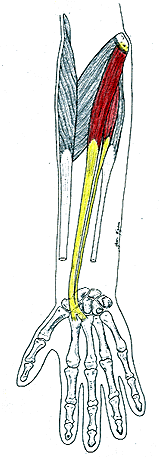
A Doubled Flexor Carpi Radialis Muscle.
from Saadeh, Kawas, and Bergman. — Anatomy Atlases. Image hosted by the site it comes from. Open the original page.
Riferimenti dell’opera originale
Elenco riportato come compare nella fonte, senza normalizzazione dei formati bibliografici.
- Anson, B.J.., Ed. (1966) Morris' Human Anatomy, 12th ed. The Blakiston Division, McGraw-Hill Book Company, New York.
- Bankart, J., Pye-Smith, P.H. and J.J. Phillips. (1869) Note of abnormalities observed in the dissecting room during sessions of 1866-67, 1867-68. Guy's Hosp. Reports 14:436-455.
- Carleton, A. (1934-35) Flexor carpi radialis brevis vel profundus. J. Anat. 69:292-293.
- Farber, J.S. and B.S. Bryan. (1968) The anterior osseous syndrome. J. Bone Joint Surg. (A) 50:521-523.
- Gruber, W. (1872) Un muscle radial interne long bicaude chez l'homme, remplacant par une portion surnuméraire le palmaire grele, qui manqué. Bull. L'Acad. Imp. Sci. St. Petersbourg 17:318-319.
- Gruber, W. (1872) Sur les varietes du muscle radial interne court. Bull. L'Acad. Imp. Sci. St. Petersbourg. 17:379-380.
- Henle, J. (1871) Handbuch der Muskellehre des Menschen, in Handbuch der systematischen Anatomie. Verlag von Friedrich Vieweg und Sohn, Braunschweig.
- Lahey, M.D. and P.L. Aulicino. (1986) Anomalous muscles associated with compression neuropathies. Orthopaedic Review 15(4):19-28.
- Macalister, A. (1868) On the nature of the coronoid portion of pronator radii teres. J. Anat. Physiol. 2:8-12.
- Macalister, A. (1875) Additional observations on muscular anomalies in human anatomy (third series), with a catalogue of the principal muscular variations hitherto published. Trans. Roy. Irish Acad. Sci. 25-1-134.
- Mori, M. (1964) Statistics on the musculature of the Japanese. Okajimas Fol. Anat. Jap. 40:195-300.
- Saadeh, F.A., Kawas, S.H. and R.A. Bergman (1990) A doubled flexor carpi radialis muscle. Gegenbaurs Morphol. Jahrbuch.(Leipzig). 136:201-204.
- Spinner, M. (1970) The anterior interosseous nerve syndrome with special attention to its variations. J. Bone Joint Surg. (A) 52:84-94.
- Spinner, M. (1978) Injuries to the Major Branches of Peripheral Nerves of the Forearm. 2nd ed. W.B. Saunders, Philadelphia.
- Wood, J. (1867) On human muscular variations and their relation to comparative anatomy. J. Anat. Physiol. 1:44-59.
Anatomical classification
- Systems:
- Muscular system
Content provenance
Adaptation
Adaptation of «Flexor Carpi Radialis — Illustrated Encyclopedia of Human Anatomic Variation: Opus I: Muscular System» by Ronald A. Bergman, Adel K. Afifi, Ryosuke Miyauchi. Source: https://www.anatomyatlases.org/AnatomicVariants/MuscularSystem/Text/F/05Flexor.shtml Original work distributed under the CC BY-NC-SA 4.0 licence (https://creativecommons.org/licenses/by-nc-sa/4.0/deed.it). Adaptation by Redazione AIVA. Changes from the original: Testo originale inglese riprodotto integralmente e riorganizzato nel formato scheda del portale (sintesi, testo, riferimenti), senza modificarne le affermazioni. La traduzione italiana non è ancora stata eseguita, e la pagina lo dichiara. Le figure non sono state copiate: sono collegate alla pagina d’origine. This publication is not approved or endorsed by the authors of the original work.
Licence
This content is distributed under the licence CC BY-NC-SA 4.0. Licences and attribution