Encyclopedia entry
Flexor Digitorum Longus Communis (Pedis)
Abstract
The deep portion of this muscle may provide slips to a variable number of digital tendons of the long flexor, most commonly to those of the second, third, and fourth toes. The tendon to the second toe may be absent and replaced by a tendon from flexor hallucis longus. A slip is sometimes provided to the fifth toe, replacing the tendon from the short flexor. Another slip passes to the tendinous connection between the tendon of flexor hallucis longus and that of flexor digitorum longus.
The deep portion of this muscle may provide slips to a variable number of digital tendons of the long flexor, most commonly to those of the second, third, and fourth toes. The tendon to the second toe may be absent and replaced by a tendon from flexor hallucis longus. A slip is sometimes provided to the fifth toe, replacing the tendon from the short flexor. Another slip passes to the tendinous connection between the tendon of flexor hallucis longus and that of flexor digitorum longus. Rarely, a slip joins the tendon of the great toe itself, and the muscle has been seen to end entirely on this tendon.
The lateral head is often missing and sometimes the whole muscle is absent. The muscle may have an accessory head arising from the tibia, fibula, calcaneus, tibialis posterior, or flexor hallucis longus.
Another accessory head arising from the crural fascia may split to join both flexor digitorum longus and flexor hallucis longus. Flexor digitorum longus itself has been found with a second long head from the fibula (Gies). It has been seen united with the usual head, and either forming a complete or partial substitute for the caro quadrata (quadratus plantae). An accessory long slip from the tibialis anticus was seen by Gies, joining the rest of the muscle at the ankle. A second long flexor, either parallel and attached to the ordinary muscle, or to the accessorius, is described by Otto, Meckel, Hall, and Reinhardt. Union has been described between the muscular parts of the flexor digitorum, and flexor hallucis. A second or superficial head has been seen going from the fascia of the leg to the long flexor. Another from the accessorius ad flexorem arose from the lateral condyle of the tibia, ended in a long tendon like that of plantaris, and was inserted into the flexor behind the os calcis.
Flexor digiti secundi proprius was found by Bahnsen as a semipenniform muscle from the back of the tibia. An accessory head of flexor digitorum longus , which crossed the posterior tibial artery was described by Glaser (1866). See also Flexor hallucis longus.
Syn.; m. Flexor digitorum pedis longus, Flexor digitorum communis longus, Flexor digitorum communis perforans, Flexor digitorum communis profundus, Flexor longus digitorum pedis.
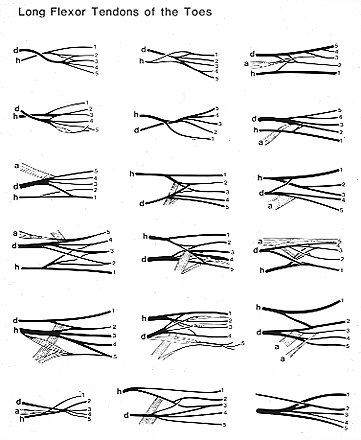
Long Flexor Tendons of the Toes .
- h= flexor hallucis longus; d= flexor digitorum longus; a= accessorius; a1 and a2 parts of accessorius when split; l1 and l2; and 1, 2, 3, 4, 5 = tendons for the supply of the respective toes.
from Macalister. — Anatomy Atlases. Image hosted by the site it comes from. Open the original page.
Riferimenti dell’opera originale
Elenco riportato come compare nella fonte, senza normalizzazione dei formati bibliografici.
- Anson, B.J., Ed. (1966) Morris' Human Anatomy. 12th ed. The Blakiston Division, McGraw Hill Book Company, New York.
- Flower, W.H. and J. Murie. (1867) Account of the dissection of a Bush woman. J. Anat. Physiol. 1:202-208.
- Barlow, T.E. (1949) An unusual anomaly of m. flexor digitorum longus. J. Anat. 83:224-226.
- Focacci, M. (1903) Etude morphologique sur les fléchisseurs longus du pied. Arch. Ital. Biol. 39:486-487.
- Gies, T. (1868) Der flexor digitorum pedis communis longus und seine Varietäten. Arch. Anat. Physiol. Wissen. Med. 1868:231:239.
- Gruber, W (1887) Ein musculus flexor brevis digiti II pedis. Arch. Path. Anat. Physiol. Klin. Med. 109:6-8.
- Gruber, W. (1887) Ein musculus flexor brevis digiti IV pedis. Arch. Path. Anat. Physiol. Klin. Med. 109:8.
- Henle, J. (1871) Handbuch der Muskellehre des Menschen, in Handbuch des systematischen Anatomie. Verlag von Friedrich Vieweg und Sohn, Braunschweig.
- Macalister, A. (1875) Additional observations on muscular anomalies in human anatomy (third series), with a catalog of the principal muscular variations hitherto published. Trans. Roy. Irish Acad. Sci. 25:1-134.
- Ottone, N.E. and Tejedor, M and Blasi, E. and Medan, C.D. and Fuentes, R. and Del Sol, M. Morphological description of the flexor digitorum accessorius longus muscle and its clinical significance. Int. J. Morphol., 33(2):611-619, 2015.
- White, S. (1884) Note respecting the course of the flexor longus digitorum pedis. J. Anat. Physiol. 18:118-119.
- Wood, J. (1866) Variations in human myology observed during the winter session of 1865-67 at King's College, London. Proc. Roy. Soc. B 15:229-244.
Anatomical classification
- Systems:
- Muscular system
Content provenance
Adaptation
Adaptation of «Flexor Digitorum Longus Communis (Pedis) — Illustrated Encyclopedia of Human Anatomic Variation: Opus I: Muscular System» by Ronald A. Bergman, Adel K. Afifi, Ryosuke Miyauchi. Source: https://www.anatomyatlases.org/AnatomicVariants/MuscularSystem/Text/F/15Flexor.shtml Original work distributed under the CC BY-NC-SA 4.0 licence (https://creativecommons.org/licenses/by-nc-sa/4.0/deed.it). Adaptation by Redazione AIVA. Changes from the original: Testo originale inglese riprodotto integralmente e riorganizzato nel formato scheda del portale (sintesi, testo, riferimenti), senza modificarne le affermazioni. La traduzione italiana non è ancora stata eseguita, e la pagina lo dichiara. Le figure non sono state copiate: sono collegate alla pagina d’origine. This publication is not approved or endorsed by the authors of the original work.
Licence
This content is distributed under the licence CC BY-NC-SA 4.0. Licences and attribution