Voce enciclopedica
Deltoideus
Abstract
This muscle arises from the lateral border and upper surface of the acromion, from the ventral and upper surface of the lateral part of the clavicle, and from the spine of the scapula. The clavicular and even the acromial part of this muscle may be missing. Rarely, the muscular sheet may be split into three main parts that are more or less separated from each other; the independence of the acromial part was reported by Macalister and by Mori.
This muscle arises from the lateral border and upper surface of the acromion, from the ventral and upper surface of the lateral part of the clavicle, and from the spine of the scapula. The clavicular and even the acromial part of this muscle may be missing. Rarely, the muscular sheet may be split into three main parts that are more or less separated from each other; the independence of the acromial part was reported by Macalister and by Mori.
Mori reported the separation of the acromial part from the remainder of the deltoid muscle as follows: Complete separation......................12 arms (24%). Incomplete separation....................19 arms (38%). No separation............................19 arms (38%), the separation of the clavicular part from the remainder of the muscle: Complete separation.......................2 arms (4%). Incomplete separation.....................2 arms (4%). No separation............................46 arms (92%), and the origin from the scapular spinous part, from the fascia of infraspinatus, or from both: From spine only..........................16 arms (32%). From both the spine and the infraspinatus fascia.....31 arms (62%). From the infraspinatus fascia only....................3 arms (6.0%).
One or more parts may be deficient or absent.
The blending of trapezius with deltoideus may occur. Accessory slips may join the deltoid with infraspinatus, latissimus dorsi, or even teres major. Also, additional slips are seen arising from the vertebral border of the scapula and joining the dorsal part of the muscle or expanding into the fascia of the arm, e.g., infraspinatohumeralis.
Another head, costodeltoideus (Calori), may arise from the lateral edge of the scapula between teres minor and infraspinatus or between teres major and minor. Well-developed accessory slips have been observed arising from the spine of the scapula or the infraspinatus fascia and inserting into the humerus between the deltoid and triceps or into the fascia of the arm.
Still another muscle head (basio-deltoideus Meckelii of Calori) arises from infraspinatus fascia and inserts into the posterior edge of the clavicular head of deltoideus.
Acromiocalvicularis lateralis (Gruber), it arises from the acromion and inserts into the clavicular head of deltoideus. Gruber found this variation once in 140 cadavers.The deltoid may be joined to pectoralis major. It may be connected distally with brachialis and brachioradialis. The connection with the latter may be partly fleshly and partly tendinous.
The acromial portion has been found fused with brachioradialis, so that the muscle extended onto the radial border of the forearm. Occasionally some fibers arising from the scapular spine extend superficially over the surface of the muscle and end in the skin of the arm.
Syn.: m. attolens humerum, Dreieckiger Armmuskel, Deltamuskel, Armheber.
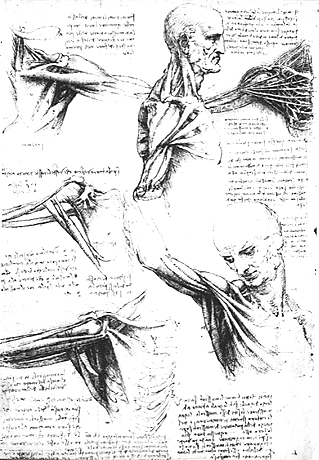
Infraspinatohumeralis and Pectoralis Major .
- Leonardo da Vinici
Anatomy Atlases. Immagine ospitata dal sito d’origine. Apri la pagina originale.
Riferimenti dell’opera originale
Elenco riportato come compare nella fonte, senza normalizzazione dei formati bibliografici.
- Chudzinski, T. (1885) Une anomalie du muscle deltoïde. Bull. Soc. Anthropol. Paris 8:10-11.
- Greinert, E. (1910) Muskelvarietat: Hautmuskel uber dem M. deltoideus. Anat. Anz. 36:643-645.
- Guber, W. (1865) Neue supernumeräre Schlüsselbeinmuskeln. Arch. Anat. Physiol. Wissen. Med. 1865:703-718.
- Gruber, W. (1872) Mangel der mittlern Portion des Musculus deltoideus. Arch. Path. Anat. Physiol. Klin. Med. 54:186-187.
- Henle, J. (1871) Handbuch der Muskellehre des Menschen, in Handbuch der systematischen Anatomie des Menschen. Verlag von Friedrich Vieweg und Sohn, Braunschweig.
- Koster, J.W. (1865) Volledige versmelting van den musc. pectoralis en deltoideus. Bericht über die Fortschritte der Anatomie und Physiologie. 1865:75-78.
- Macalister, A. (1875) Additional observations on muscular anomalies in human anatomy (third series), with a catalogue of the principal muscular variations hitherto published. Trans. Roy. Irish Acad. Sci. 25:1-134.
- Mori, M. (1964) Statistics on the musculature of the Japanese. Okajimas Folia Anatomica Japonica. 40:195-300.
- Ranson, W.B. (1885) Notes on some variations of the shoulder muscles. J. Anat. Physiol. 19:508-509.
- Schultz, A.H. (1918) The position of the insertion of the pectoralis major and deltoid muscles on the humerus of man. Am. J. Anat. 23:155-174.
Classificazione anatomica
- Sistemi:
- Sistema muscolare
Provenienza del contenuto
Adattamento
Adattamento di «Deltoideus — Illustrated Encyclopedia of Human Anatomic Variation: Opus I: Muscular System» di Ronald A. Bergman, Adel K. Afifi, Ryosuke Miyauchi. Fonte: https://www.anatomyatlases.org/AnatomicVariants/MuscularSystem/Text/D/01Deltoideus.shtml Opera originale distribuita con licenza CC BY-NC-SA 4.0 (https://creativecommons.org/licenses/by-nc-sa/4.0/deed.it). Adattamento a cura di Redazione AIVA. Modifiche rispetto all’originale: Testo originale inglese riprodotto integralmente e riorganizzato nel formato scheda del portale (sintesi, testo, riferimenti), senza modificarne le affermazioni. La traduzione italiana non è ancora stata eseguita, e la pagina lo dichiara. Le figure non sono state copiate: sono collegate alla pagina d’origine. Questa pubblicazione non è approvata né avallata dagli autori dell’opera originale.
Licenza
Questo contenuto è distribuito con licenza CC BY-NC-SA 4.0. Licenze e attribuzioni