Voce enciclopedica
Epitrochleoanconeus
Abstract
Gruber reported a study of 200 elbow regions from 100 cadavers. He found this muscle in 26 males and 8 females. The muscle was found bilaterally in 15 male and 4 females and on one side only in 11 males and 4 females. It was on the right side only in 9 males and 3 females and on the left side alone in 2 males and 1 female. Wood reported the muscle in 4 male subjects out of 36. In three instances the muscle was bilateral, and in one on the left side only.
Gruber reported a study of 200 elbow regions from 100 cadavers. He found this muscle in 26 males and 8 females. The muscle was found bilaterally in 15 male and 4 females and on one side only in 11 males and 4 females. It was on the right side only in 9 males and 3 females and on the left side alone in 2 males and 1 female.
Wood reported the muscle in 4 male subjects out of 36. In three instances the muscle was bilateral, and in one on the left side only. It is possible that the difference between the two studies may not be mathematical but due possibly to different, geographically isolated, or circumscribed, gene pools rather than to "racial" differences.
Macalister found the following variations for this "little muscle (that is) frequently overlooked." Mr Wood (1868) found it four times in thirty-six subjects (three times in both arms. and once in the left arm only). Wood also found it once in 1867 (in thirty-six subjects), and once in 34 subjects in 1866. The average frequency would be once in every five subjects. Macalister found it sixteen times in sixty-three subjects. The frequency is then about forty-eight in two hundred. Its origin is from the back of the medial condyle of the humerus, and may be
- narrow
- wide and fleshy
- tendinous. It is usually placed on a level above and behind the condyloid origin of flexor carpi ulnaris. Its insertion is into the olecranon process, and its subjacent fascia.Gruber found this muscle:
- with two heads, one above the other
- in another instance the muscle was doubled
- it is sometimes triangular
- but more commonly and typically it is a flat, rectangular band
- Gruber also found it fleshy in the middle, and tendinous at both ends.
It usually runs backward, with a slight downward obliquity, and always covers the ulnar nerve. The ulnar nerve may, under certain conditions, undergo compression compromising structures innervated by this large and important peripheral nerve supplying one and "one-half" muscles in the forearm and usually, most of the intrinsic hand muscles except those of the thenar eminence and a few others. Its existence was noticed by Koster who named it Anconeus quintus. See also Triceps brachii and Flexor carpi ulnaris.
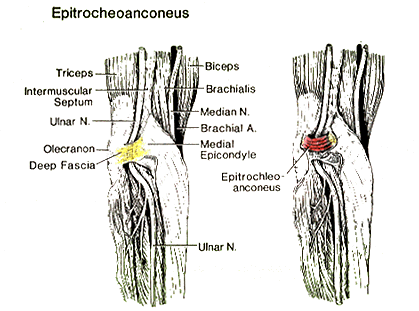
Epitrochleoanconeus .
from Gruber, 1867 — Anatomy Atlases. Immagine ospitata dal sito d’origine. Apri la pagina originale.
Riferimenti dell’opera originale
Elenco riportato come compare nella fonte, senza normalizzazione dei formati bibliografici.
- Gruber, W. (1866) Über die muskel epitrochleo-anconeus des menschen und den Saugethieren. Mem. Imp. Acad. Sci. St. Petersbourg. 1866:1-26.
- Macalister, A. (1875) Additional observations on muscular anomalies in human anatomy (third series), with a catalogue of the principal muscular variations hitherto published. Trans. Roy. Irish Acad. Sci 25:1-134.
Classificazione anatomica
- Sistemi:
- Sistema muscolare
Provenienza del contenuto
Adattamento
Adattamento di «Epitrochleoanconeus — Illustrated Encyclopedia of Human Anatomic Variation: Opus I: Muscular System» di Ronald A. Bergman, Adel K. Afifi, Ryosuke Miyauchi. Fonte: https://www.anatomyatlases.org/AnatomicVariants/MuscularSystem/Text/E/02Epitrochleoanconeus.shtml Opera originale distribuita con licenza CC BY-NC-SA 4.0 (https://creativecommons.org/licenses/by-nc-sa/4.0/deed.it). Adattamento a cura di Redazione AIVA. Modifiche rispetto all’originale: Testo originale inglese riprodotto integralmente e riorganizzato nel formato scheda del portale (sintesi, testo, riferimenti), senza modificarne le affermazioni. La traduzione italiana non è ancora stata eseguita, e la pagina lo dichiara. Le figure non sono state copiate: sono collegate alla pagina d’origine. Questa pubblicazione non è approvata né avallata dagli autori dell’opera originale.
Licenza
Questo contenuto è distribuito con licenza CC BY-NC-SA 4.0. Licenze e attribuzioni