Voce enciclopedica
Flexor Carpi Ulnaris
Abstract
In one case, the anterior fibers of this muscle formed an accessory muscle that joined the main belly below the middle of the forearm; it was supplied not by the ulnar but rather by the median nerve. Because its two heads are completely independent and usually supplied by the ulnar nerve, it has been suggested that the muscle is formed developmentally of two elements that fuse. It may however, remain doubled and not fuse. An additional slip of origin from the medial side of the coronoid process is often present.
In one case, the anterior fibers of this muscle formed an accessory muscle that joined the main belly below the middle of the forearm; it was supplied not by the ulnar but rather by the median nerve. Because its two heads are completely independent and usually supplied by the ulnar nerve, it has been suggested that the muscle is formed developmentally of two elements that fuse. It may however, remain doubled and not fuse. An additional slip of origin from the medial side of the coronoid process is often present. Partial insertion into the flexor retinaculum has been recorded and its attachment to the fifth metacarpal may extend to the fourth or even the third metacarpal bone by the radial expansion of a pisimetacarpal band of fibers. Extension of the fibers to the capsule of the fifth metacarpophalangeal joint has been observed. The occurrence of a slip connecting the tendon with the abductor of the little finger has also been reported.
Variations of flexor carpi ulnaris, reported by Macalister, follow: 1. With an origin from the triceps (Jenty); 2. With a slip to the fourth metacarpal bone (Wood and Macalister); 3. Having a slip to the annular ligament, without or with a coexisting palmaris longus; the latter form was seen by Harrison and Macalister and the former was seen by Winslow and also by Macalister; 4.In a case of Koster, flexor carpi ulnaris was inserted into the interosseus membrane; 5. Friedlowaky described a muscle that sent a slip into the annular ligament, and the palmaris longus was suppressed.
The epitrochleoanconeus (epitrochleoolecranonis or anconeus sextus [Gruber]) is a rare, small muscle closely associated with flexor carpi ulnaris. It arises from the posterior surface of the medial epicondyle of the humerus and is inserted onto the olecranon process. It is superficial to the ulnar nerve, from which it receives its innervation, and takes the place of a fibrous arch of deep fascia, usually found in the same location. The muscle may compromise the function of the ulnar nerve. The muscle has been reported present in about 25% of bodies. It is consistently found in amphibians, reptiles, and some primates.
Syn.: m. Ulnaris Internus, Ellenbogenbeuger der Hand, Innerer Ellenbogenbeuger, Innerer Ellenbogenmuskel, Cubital Anterieur (Cruveilhier).
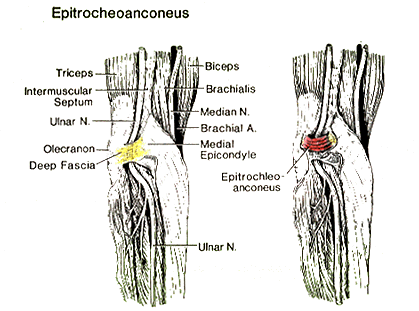
Epitrochleoanconeus
- Redrawn and modified from an illustration in Toldt, C.
- In "An Atlas of Human Anatomy for Students and Physicians".
Anatomy Atlases. Immagine ospitata dal sito d’origine. Apri la pagina originale.
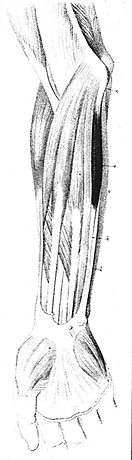
Doubled Flexor Carpi Ulnaris.
from Calori. — Anatomy Atlases. Immagine ospitata dal sito d’origine. Apri la pagina originale.
Riferimenti dell’opera originale
Elenco riportato come compare nella fonte, senza normalizzazione dei formati bibliografici.
- Calori, L. (1868) Delle anomalie più importanti di ossa, vasi, nervi, e muscoli occorse nell'ultimo biennio fascendo anatomia del corpo umano. Mem. R. Accad. Sci. Istituto di Bologna S. 2. 8:417-482.
- Curnow, J. (1873) Notes of some irregularities in muscles and nerves. J. Anat. Physiol. 7:304-309.
- Galton, J.C. (1875) On the epitrochleo-anconeus or anconeus sextus (Gruber). J. Anat. Physiol. 9:169-175.
- Gruber, W. (1881) Ein musculus ulnaris brevis beim Menschen. Arch. Path. Anat. Physiol. Klin. Med. 86:15-19.
- Hirasawa, Y., Sawamura, H., and K. Sakakida. (1979) Entrapment neuropathy due to bilateral epitrochleoanconeus muscles. A case report. J. Hand Surg. 4:181-184.
- Jansen, J.H. (1850) Waarnemingen van anomale spieren. Nederlandsch Lancet 1850:431-437.
- Macalister, A. (1875) Additional observations on muscular anomalies in human anatomy (third series), with a catalogue of the principal muscular variations hitherto published. Trans. Roy. Irish Acad. Sci. 25:1-134.
- Reid, R.W. and S. Taylor. (1879) Anatomical variations. Reports. St. Thomas's Hospital 9:47.
- Toldt, C. (1928) An Atlas of Human Anatomy for Students and Physicians, 2nd ed. Vol. 1. The Macmillian Co., New York.
- Wood, J. (1866) Variations in human myology observed during the winter session of 1865-66 at King's College, London. Proc. Roy. Soc. Lond. B 15:229-244.
Classificazione anatomica
- Sistemi:
- Sistema muscolare
Provenienza del contenuto
Adattamento
Adattamento di «Flexor Carpi Ulnaris — Illustrated Encyclopedia of Human Anatomic Variation: Opus I: Muscular System» di Ronald A. Bergman, Adel K. Afifi, Ryosuke Miyauchi. Fonte: https://www.anatomyatlases.org/AnatomicVariants/MuscularSystem/Text/F/09Flexor.shtml Opera originale distribuita con licenza CC BY-NC-SA 4.0 (https://creativecommons.org/licenses/by-nc-sa/4.0/deed.it). Adattamento a cura di Redazione AIVA. Modifiche rispetto all’originale: Testo originale inglese riprodotto integralmente e riorganizzato nel formato scheda del portale (sintesi, testo, riferimenti), senza modificarne le affermazioni. La traduzione italiana non è ancora stata eseguita, e la pagina lo dichiara. Le figure non sono state copiate: sono collegate alla pagina d’origine. Questa pubblicazione non è approvata né avallata dagli autori dell’opera originale.
Licenza
Questo contenuto è distribuito con licenza CC BY-NC-SA 4.0. Licenze e attribuzioni