Voce enciclopedica
Flexor Pollicis Longus
Abstract
Flexor pollicis longus is uniquely human. In other primates there is only one common deep flexor that provides a tendon to the thumb. In some cases, this condition is exactly duplicated in humans; in other cases, the muscle has been found fused with the index tendon of flexor digitorum profundus (as in the gorilla and chimpanzee). A deep accessory muscle was found, which bifurcated to join both flexor pollicis longus and flexor digitorum profundus (the tendon to flexor indicis).
Flexor pollicis longus is uniquely human. In other primates there is only one common deep flexor that provides a tendon to the thumb. In some cases, this condition is exactly duplicated in humans; in other cases, the muscle has been found fused with the index tendon of flexor digitorum profundus (as in the gorilla and chimpanzee). A deep accessory muscle was found, which bifurcated to join both flexor pollicis longus and flexor digitorum profundus (the tendon to flexor indicis). The index tendon may split and two tendons may insert on the index finger; it may also give a tendinous slip to the first lumbrical.
Another slip may attach to the synovial bursa forming a tensor bursae mucosae tendinum. Fleshy slips are sometimes present uniting the belly of flexor pollicis longus with flexor digitorum superficialis or profundus.These, as well as humeral and coronoid heads, are indications of the original connection between the divisions of the deep flexor sheet of muscles.The accessory coronoid head is subject to some variation, occasionaly being divided distally into two or three slips passing to flexor pollicis longus, flexor digitorum profundus, flexor digitorum superficialis, or pronator teres. Pronator teres may give some fasciculi to the flexor of the thumb.
Flexor pollicis longus may arise from brachialis.
According to Macalister, flexor pollicis longus has been seen:
- With a accessorius ad pollicem (Gantzer), present in forty out of 102 subjects (Wood). This may be distinct from the coronoid head of the sublimis (superficialis) , or may be blended with it; and he has occasionally found it receiving a slip from the condyloid fibers of sublimis. Macalister found Gantzer's muscle to exist in the proportion of twice in every five subjects.
- Both Macalister and Wood found flexor pollicis longus (fpl) providing a tendon to the first lumbrical.
- A common slip from the coronoid process was found providing 1st, the coronoid head of the pronator teres; 2nd, a fleshy belly to the flexor pollicis, deep to which a slip for the flexor sublimis arose
- Another common coronoid slip was found trifurcating and terminating in the three-flexor pollicis, profundus and sublimis
- A slip from the medial condyle, forming an accessory head
- A coronoid head was found arising from the place where the second head of the pronator teres usually arises. The pronator head was absent. The slip was joined by a fasciculus from the flexor sublimis (superficialis), which passed beneath the ulnar artery, and ended in the flexor pollicis.
- A head may arise from brachialis
- A head may also arise from the middle of the superficial layer of the pronator teres
- Sömmerring saw it doubled
- a common condyloid head provided a slip to flexor pollicis, and to the indicial slip of the flexor profundus.
- A slip from the coronoid process was found ending in two parts-one to pronator teres, the second forming a belly, three inches (~9.5 cm) long, which ran to the flexor pollicis; in this case a separate slip went to profundus
- Fpl has been seen providing a tendon to the index finger, which does not join with the indicial tendon of the flexor profundus, but, running separately in the sheath,was inserted onto the ungual (distal) phalanx
- Cases of slips, sent from this muscle to the flexor profundus, have been described by Loschge, Wood and by Macalister
- An accessory muscle, found in an idiot, arose partly from the proundus and partly from the sublimis (superficialis) became tendinous just proximal to the annular ligament, divided into two-one for flexor pollicis, and one for the flexor profundus of the index finger
- The absence of Fpl is described by Gegenbaur
- In a case of double thumb, Gruber found it sending a slip to both digits.
Mori's observations complement those of Macalister. Mori found Gantzer's fasciculus (muscle) arising from the medial epicondyle of the humerus in 24% of his cases, from the coronoid process of the ulna in 68%, and jointly from the medial epicondyle and from the coronoid process in 8%
Gantzer's Muscle Races of Man
Authors
%
Caucasian (European)
LeDouble
33.3
Caucasian (European)
Wood
39
Blacks
Loth
89.3
Aino
Sano
70.0
Asian (Japanese)
Adachi
62.7
Asian (Japanese)
Inoue
71.0
Asian (Japanese)
Mori
50
Mori also points out that the terminal tendon and Gantzer's muscle also varies.
- The terminal tendon of flexor pollicis longus (fpl) may arise from Gantzer's muscle (40%).
- The terminal tendon may arise from the two bellies of fpl and Gantzer's muscle (40%).
- The terminal tendon of fpl may arise from the point of fusion of fpl and Gantzer's muscle (16%) and
- the tendon from fpl and the tendon of Gantzer's muscle fuse together to form one tendon (4%).
Mori also points out other relationships of fpl; Fpl and flexor digitorum profundus may be joined by a muscular slip (12.5%); a tendinous slip from the terminal tendon of fpl may be fused with the terminal tendon of profundus (fdp) for the index finger (7.5%); Gantzer's fasciculus may be divided into two parts, and the terminal tendon of the first part is fused with the fpl and the terminal tendon from the second part goes distally to fuse with the tendon of fdp for the index finger.
The fpl may not arise from the interosseous membrane in 7.5% of cases.
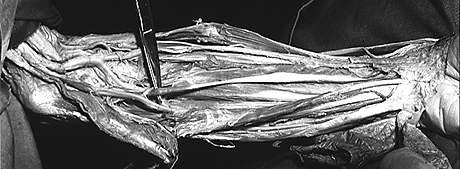
Gantzer's Muscle joining flexor pollicis longus.
Laboratory specimen, University of Iowa. — Anatomy Atlases. Immagine ospitata dal sito d’origine. Apri la pagina originale.

Gantzer's Muscle.
from Schäfer and Thane, Quain's Anatomy. — Anatomy Atlases. Immagine ospitata dal sito d’origine. Apri la pagina originale.
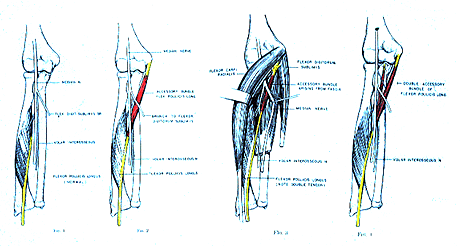
Varieties of Gantzer's Muscle.
from Mangini. — Anatomy Atlases. Immagine ospitata dal sito d’origine. Apri la pagina originale.
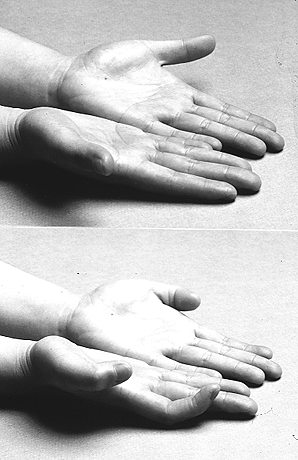
The Thumb and Index Finger share a common tendon.
- The source of the common tendon is not known in this case, but flexor pollicis longus is frequently partially doubled and is known to give rise to an accessory tendon that extends to the index finger.
From a Graduate Student. — Anatomy Atlases. Immagine ospitata dal sito d’origine. Apri la pagina originale.
Riferimenti dell’opera originale
Elenco riportato come compare nella fonte, senza normalizzazione dei formati bibliografici.
- Anson, B.J., Ed. (1966) Morris' Human Anatomy.12th ed., The Blakiston Division, McGraw-Hill Book Company, New York.
- Dykes, J. and B.J. Anson. (1944) The accessory tendon of the flexor pollicis longus muscle. Anat. Rec. 90:83-87.
- Gegenbaur, C. (1861) Ein Fall von mehrfachen Muskelanomalien an der oberen Extremität. Arch. Path. Anat. Physiol. Klin. Med. 21:376-385.
- Gruber, W. (1872) Zergleiderung eines linken Armes mit Duplicitat des Daumens. Bull. Acad. Imp. Sci. St.-Petersbourg. 17:24-31.
- Hall, H.S. (1903) Complete absence of the superficial flexors of the thumb and concurrent anomalies. J. Anat. Physiol. 38:287-289.
- LeDouble, A.F. (1897) Traité des Variations du Système Musculaire de l'Homme et Leur Signification au Point de Vue de l'Anthropologie Zoologique, Libraire C. Reinwald, Ed., Schleicher Frères, Paris.
- Linburg, R.M. and B.E. Comstock. (1979) Anomalous tendon slips from the flexor pollicis longus to flexor digitorum profundus. J. Hand Surg. 4:79-83.
- Macalister, A. (1875) Additional observatins on muscular anomalies in human anatomy (third series), with a catalogue of the principal musclular variations hitherto published. Trans. Roy. Irish Acad. Sci. 25:1-134.
- Malhotra, V.K., Singh, N.P. and S.P. Tewari. (1982) The accessory head of the flexor pollicis muscle and its nerve supply. Anat. Anz. 151:503-505.
- Mangini, U. (1960) Flexor pollicis longus muscle. J. Bone Joint Surg. (A) 42(3):467-470.
- Mori, M. Statistics on the musculature of the Japanese. Okajimas Fol. Anat. Jap. 40:195-300.
- Schäfer, E.A. and G.D. Thane., Eds. (1894) Quain's Anatomy, 10th ed. Longmans, Green, and Co., London
- Usami, F. (1987) Bilateral congenital absence of the flexor pollicis longus with craniofacial abnormalities. J. Hand Surg. (Am) 12:603-604.
- Wagstaffe, W.W. (1872) Partial deficiency of the tendon of the long flexor of the thumb. J. Anat. Physiol. 6:212-214.
- Wilkinson, J.L. (1953) The insertions of the flexores pollicis longus et digitorum profundus. J. Anat. 87:75-88.
Classificazione anatomica
- Sistemi:
- Sistema muscolare
Provenienza del contenuto
Adattamento
Adattamento di «Flexor Pollicis Longus — Illustrated Encyclopedia of Human Anatomic Variation: Opus I: Muscular System» di Ronald A. Bergman, Adel K. Afifi, Ryosuke Miyauchi. Fonte: https://www.anatomyatlases.org/AnatomicVariants/MuscularSystem/Text/F/22Flexor.shtml Opera originale distribuita con licenza CC BY-NC-SA 4.0 (https://creativecommons.org/licenses/by-nc-sa/4.0/deed.it). Adattamento a cura di Redazione AIVA. Modifiche rispetto all’originale: Testo originale inglese riprodotto integralmente e riorganizzato nel formato scheda del portale (sintesi, testo, riferimenti), senza modificarne le affermazioni. La traduzione italiana non è ancora stata eseguita, e la pagina lo dichiara. Le figure non sono state copiate: sono collegate alla pagina d’origine. Questa pubblicazione non è approvata né avallata dagli autori dell’opera originale.
Licenza
Questo contenuto è distribuito con licenza CC BY-NC-SA 4.0. Licenze e attribuzioni