Voce enciclopedica
Lumbar Arteries
Abstract
One or more pairs of the lumbar arteries may arise as a common stem from the back of the aorta. The first lumbar may be joined at its origin with the lowest intercostal artery; the third and fourth lumbar, or less often the second and third lumbars, may arise from the aorta as a common stem. The fifth pair is sometimes absent. One or both of the last pair of lumbar arteries may arise in common with the middle sacral.
One or more pairs of the lumbar arteries may arise as a common stem from the back of the aorta.
The first lumbar may be joined at its origin with the lowest intercostal artery; the third and fourth lumbar, or less often the second and third lumbars, may arise from the aorta as a common stem.
The fifth pair is sometimes absent.
One or both of the last pair of lumbar arteries may arise in common with the middle sacral.
On the fifth lumbar vertebra, the place of a lumbar artery is often taken by a branch from the middle sacral artery, and the iliolumbar ( a branch of the internal iliac, posterior division) compensates for the absence of the lumbar artery among the muscles usually supplied by the lumbar artery.
The first lumbar may provide the inferior phrenic or middle suprarenal.
On occasion, one of the lumbar arteries provides the gonadal artery.
The fourth lumbar on either side may provide the middle sacral, or both arteries arise as a common stem with the middle sacral.
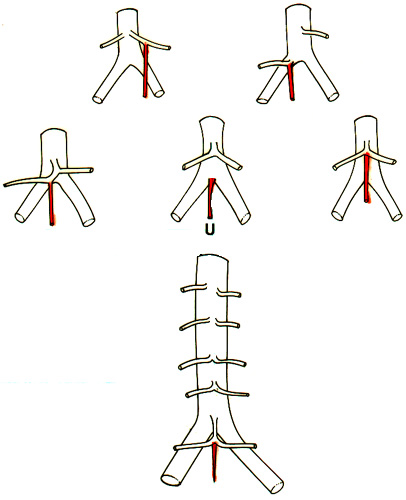
Anatomy Atlases. Immagine ospitata dal sito d’origine. Apri la pagina originale.
Riferimenti dell’opera originale
Elenco riportato come compare nella fonte, senza normalizzazione dei formati bibliografici.
- Anson, B.J. and C.B. McVay. (1936) The topographial positions and the mutual relations of the visceral branches of the abdominal aorta. A study of 100 consectutive cadavers. Anat. Rec. 67:7-15.
- Bergman, R.A., Thompson, S.A., Afifi, A.K. and F.A. Saadeh. (1988) Compendium of Human Anatomic Variation: Catalog, Atlas and World Literature. Urban & Schwarzenberg, Baltimore and Munich.
- Henle, J. (1868) Handbuch der Systematischen Anatomie des Menschen. Von Freidrich Vieweg und Sohn, Braunschweig.
- Kostinovitch, L. I. (1937) A case of simultaneousl occurrence of a number of variations of the visceral branches of the abdominal aorta. Anat. Rec. 67:399-403.
- Poynter, C.W.B. (1922) Congenital anomalies of the arteries and veins of the human body with bibliography. The University Studies of the University of Nebraska. 22:1-106.
- Turner, W. (1863) On the existence of a system of anastomosing arteries between and connecting the visceral and parietal branches of the abdominal aorta. Br. Foreign Med. Rev. 32:222-227.
- Tyrie, C.C.B. (1894) Axial rotation of abdominal aorta, with associated abnormalities of the branches. J. Anat. Physiol. 28:281-287.
Classificazione anatomica
- Sistemi:
- Sistema cardiovascolare
Provenienza del contenuto
Adattamento
Adattamento di «Lumbar Arteries — Illustrated Encyclopedia of Human Anatomic Variation: Opus I: Muscular System» di Ronald A. Bergman, Adel K. Afifi, Ryosuke Miyauchi. Fonte: https://www.anatomyatlases.org/AnatomicVariants/Cardiovascular/Text/Arteries/Lumbar.shtml Opera originale distribuita con licenza CC BY-NC-SA 4.0 (https://creativecommons.org/licenses/by-nc-sa/4.0/deed.it). Adattamento a cura di Redazione AIVA. Modifiche rispetto all’originale: Testo originale inglese riprodotto integralmente e riorganizzato nel formato scheda del portale (sintesi, testo, riferimenti), senza modificarne le affermazioni. La traduzione italiana non è ancora stata eseguita, e la pagina lo dichiara. Le figure non sono state copiate: sono collegate alla pagina d’origine. Questa pubblicazione non è approvata né avallata dagli autori dell’opera originale.
Licenza
Questo contenuto è distribuito con licenza CC BY-NC-SA 4.0. Licenze e attribuzioni