Voce enciclopedica
Lumbar Vertebrae
Abstract
The first lumbar, instead of the twelfth thoracic vertebra, may present the transitional form of articular process. A lumbar rib may be present, united with the ventral surface of the transverse process or the tip of a short transverse process. The accessory rib may be elongated but is usually rudimentary. Lumbar ribs are less important clinically than cervical ribs and are usually mere rudiments An extra levator costae muscle is associated with a lumbar rib. In 559 skeletons of the Washington University collection, 8.8% had lumbar ribs (Lanier, 1944).
The first lumbar, instead of the twelfth thoracic vertebra, may present the transitional form of articular process. A lumbar rib may be present, united with the ventral surface of the transverse process or the tip of a short transverse process. The accessory rib may be elongated but is usually rudimentary. Lumbar ribs are less important clinically than cervical ribs and are usually mere rudiments An extra levator costae muscle is associated with a lumbar rib. In 559 skeletons of the Washington University collection, 8.8% had lumbar ribs (Lanier, 1944).
Occasionally, the mamillary and accessory processes are united by a bony bridge forming a foramen behind the transverse process.
The transverse process of the fourth lumbar has been reported arising from the side of the vertebral body and having no connection with either the arch or pedicle.
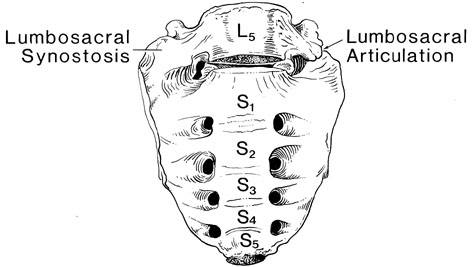
The fifth lumbar vertebra is subject to numerous variations of several sorts, of which the following two are of interest. In the first, the pedicles of the arch show a remarkable deviation, a complete dissolution of the continuity of the arch immediately caudal to the superior articular processes, differing from the conditions found in parts of the column. In a large series of skeletons (4,200), the incidence was about 4.2% (Roche and Rowe) .
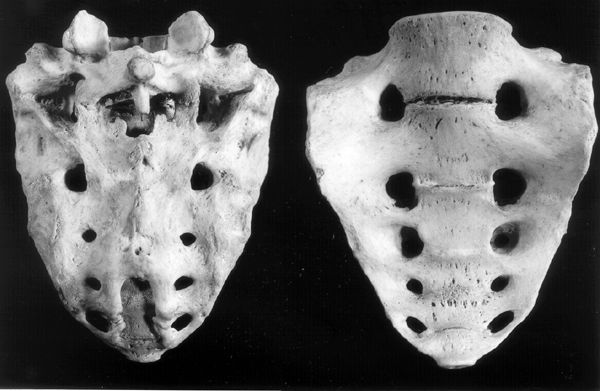
Lumbosacral transitional vertebrae were found to vary by race. It was reported that they were present in 18% of Australian aboriginals (Mitchell), 16% of Indians (Bustami), 10% of Arabs (Bustami), 8.1% of natives of Britain (Brailsford), and 5.8% of Japanese (Toyoda). Bustami studied 340 sacra of two population groups (Arab and Indian). Of these 340 sacra, 32 or 9.4% showed evidence of unilateral sacralization and 14 or 4.1% showed bilateral sacralization. Lumbarization was no found in the 340 sacra examined. Sacralization was present to some degree in 46 specimens (13.5%). The incidence of total sacralization was 10% in Arab and was 16% in Indian population groups. Arab males had a higher incidence in all stages of sacralization while it was the Indian females that showed the higher incidence in their group.
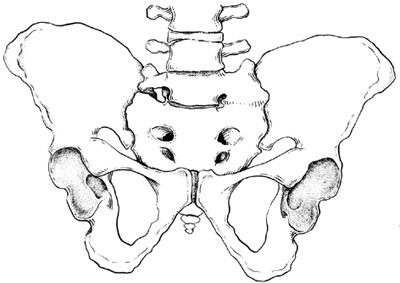
In these specimens the anterior part consists of the vertebral body carrying the pedicles and the transverse and superior articular processes, whereas the posterior segment is composed of the lamina and the spinous and inferior articular processes. This condition is occasionally present, either unilaterally or bilaterally, in the other lumbar vertebrae and even in the thoracic vertebrae. In the second type, the fifth lumbar shows a tendency, on one or both sides, to conform to the type of the first sacral vertebra, with which it may become fused. However, there may only be four lumbar vertebrae. Failure of the union of the halves of the vertebral arch and defective laminae, in this and other regions of the column, are found in spina bifida.
Lumbosacral facets are variable. In an x-ray study of 3000 subjects, the facets faced backward in 57%, pointed inward in 12%, and were mixed or asymmetric in 31% of cases.
Variations in Lumbar Ribs
Lumbar Sacralization
Anatomy Atlases. Immagine ospitata dal sito d’origine. Apri la pagina originale.
Lumbar Sacralization
Anatomy Atlases. Immagine ospitata dal sito d’origine. Apri la pagina originale.
Lumbar Vertebra
Anatomy Atlases. Immagine ospitata dal sito d’origine. Apri la pagina originale.
Riferimenti dell’opera originale
Elenco riportato come compare nella fonte, senza normalizzazione dei formati bibliografici.
- Anderson, R.J. (1883) Observations on the diameters of human vertebrae in different regions. J. Anat. Physiol. 17:341-344.
- Andrew, J. (1954-55) Sacralization: An aetiological factor in lumbar intervertebral disc lesions, and a cause of misleading focal signs. Brit. J. Surg. 42:304-311.
- Armstrong, J.R., Crisp, E.J., Freedman, B., Gillespie, H.W., Golding, F.C., Jackson, H. and K. Lloyd. (1950) Discussion on the significance of congenital abnormalities of the lumbrosacral region. Proc. R. Soc. Med. 43:635-640.
- Badgley, C.E. (1941) The articular facets in relation to low-back pain and sciatic radiation. J. Bone Joint Surg. 23:481-496.
- Barsony, T. and K. Winkler (1937) Beiträge zur Röntgenologie der Wirbelsäule. Röntgenpraxis 9:601-608.
- Brailsford, J.F. (1928-29) Deformities of the lumbosacral region of the spine. Brit. J. Surg. 16:562-627.
- Braun, H. (1955) Seltene Anomalien der Wirbelsäule. Fortschr. Röntgenstr. 82:126-127.
- Brocher, J.E.W. (1938) Mehrfach angeborene Fehlbildung der Wirbelsäule. Fortschr. Röntgenstr. 58:440-447.
- Bustami, F. (1989) The anatomical features and functional significance of lumbar transitional vertebra. Jordan Med. J. 23(1):49-59.
- Colcher, A.E. and A.M.W. Hursh. (1952) Pre-employment low-back x-ray survey. A review of 1,500 cases. Industr. Med. 21:319-321.
- Constantin, L. and R. Paleirac. (1952) Anomalies transsitionelles de la charnière dorso-lumbaire et lombaiges. J. Radiol. Electrol. 33:167.
- Cramer, K. (1908) über Rückgratsverkrümmungen bei lumbosakralen Assimilationswirbeln. Z. Orthop. Chir. 22:68-89.
- Danforth, M.S. and P.D. Wilson (1925) The anatomy of the lumbosacral region in relation to sciatic pain. J. Bone Joint Surg. 7:109-160.
- Davis, P.R. (1955) The thoraco-lumbar mortice joint. J. Anat. 89:370-377.
- Decker, H.R. (1915) Report of the anomalies in a subject with a supernumerary lumbar vertebra. Anat. Rec. 9:181-189.
- DeCocq, E. (1933) Anomalies of the lumbosacral spine. Am. J. Surg. 22:118-126.
- Diethelm, L. (1943) Zur Kenntnis der Entwicklungsgeschichte der Wirbelsäule und der Wirbelkörperfehlbildungen. Fortschr. Röntgenstr. 69:143-150.
- Dubreuil-Chambardel, L. (1921) Notes anatomiques a propos de la sacralization de la cinguième vertèbre lombaire. Bull. et Mém. de la Soc. d'Anthrop. de Paris 2:157-167.
- Dwight, T. (1902) A transverse foramen in the last lumbar vertebra. Anat. Anz. 20:571-572.
- Ehara, S., El-Khoury, G.Y. and R.A. Bergman. (1990) The target pedicle. A radiographic/anatomic correlation. Radiology 174:871-872.
- Feiteira, -., Souza, -. and H. Monteiro. (1922) A sacralizagção da último vértebra lombar. (Die Sakralisierung des letzten Lendenwirbels.) A Medicina Moderna, Nr. 346, Porto.
- Gillespie, H.W. (1949) The significance of congenital lumbo-sacral abnormalities. Brit. J. Radiol. 22:270-275.
- Gladstone, R.J. (1897) Case of an additional presacral vertebra. J. Anat. Physiol. 31:530-538.
- Gómez Oliveros, L. (1948) Observaciones anatómicas de tres casos de sacralizatión de la quinta vértebra lumbar. Cirugia Aparato Locomotor 5:29-35. Cited in Excerpta Medica. Sec. 1, Vol. 3, abstract 382, 1949.
- Günsel, E. (1953) Ein grosser Processus styloideus an der Lendenwirbelsäule. Fortschr. Röntgenstr. 79:245-246.
- Harris, H.A. (1933) Ossification in the lumbo-sacral region. Brit. J. Radiol. 6:685-688.
- Keim, H.A. and R.D. Keagy. (1967) Congenital absence of lumbar articular facets: A report of three cases. J. Bone Joint Surg. (Am) 49:523-526.
- Kiefer, H. and J. Emmrich. (1964) Abnorm grosser Processus styloides der Lendenwirbelsäule mit reaktiver Pseudoarthrosebildung. Fortschr. Röntgenstr. 100:280-281.
- Lanier, R.R., Jr. (1939) The presacral vertebrae of american white and negro males. Am. J. Phys. Anthropol. 75:341-420.
- Lanier, R.R., Jr. (1944) Length of first, twelfth, and accessory ribs in American Whites and Negroes: Their relationship to certain vertebral variations. Am. J. Phys. Anthropol. N.S. 2:137-146.
- LeDouble, A.F. (1911) Cotes lombaires dans 1'esprèce humaine. Bull. et Mém. de la Soc. d'Anthrop. de Paris 2:413-427.
- Lewin, T. (1968) Anatomical variations in lumbo-sacral synovial joints with particular references to subluxation. Acta Anat. 71:229-248.
- Manners-Smith, T. (1909) The variability of the last lumbar. J. Anat. Physiol. 43:146-160.
- Mitchell, G.A.G. (1936-37) The significance of lunbosacral vertebrae. Brit. J. Surg. 24:147-158.
- Moore, B.H. (1923) Abnormalities of the fifth lumbar transverse processes associated with sciatic pain. J. Bone Joint Surg. 5:212-224.
- Moore, B.H. (1925) Sacralization of the fifth lumbar vertebra. J. Bone Joint Surg. 7:271-278.
- Mutel, -. (1926) Les déhiscences normales lombo-sacres. Assoc. Anatomistes Comptes Rendus 21:422-429.
- Nathan, H. and B. Arensburgh. (1972) An usual variation in the fifth lumbar and sacral vertebrae: A possible cause of vertebral canal narrowing. Anat. Anz. 132:137-148.
- Nishi, K. (1928) Beiträge zum Studium der Präsakralwirbel bei verschiedenen Menschenrassen. Folia Anat. Jpn. 6:1-101.
- Nutter, J.A. (1914) Congenital anomalies of the fifth lumbar vertebra and the consequences. J. Anat. Physiol. 48:24-36.
- Papillault, G. (1898) Variations numériques des vertebres lombaires chez l'homme, leurs causes et leur relation avec une anomalie musculaire exceptionelle. Bull. et Mém. de la Soc. d'Anthrop. de Paris 9:198-222.
- Phesant, H.C. and P.C. Swenson. (1942) The lumbosacral region. A correlation of the roentgenographic and anatomical observations. J. Bone Joint Surg. (Am) 24:299-306.
- Pirkey, E.L. and J.H. Purcell. (1957) Agenesis of lumbosacral vertebrae. A report of two cases in living infants. Radiology 69:726-729.
- Roche, M.B. and G.G. Rowe. (195 1) Anomalous centers of ossification for inferior articular processes of the lumbar vertebrae. Anat. Rec. 109:253-259.
- Roche, M.B. and G.G. Rowe. (1952) The incidence of separate neural arch and coincident bone variations. A summary. J. Bone Joint Surg. (Am) 34:491-494.
- Rowe, G.G. (1950) Anomalous vertebrae from the lumbo-sacral column of man. Anat. Rec. 107:171-179.
- Russell, H.E. and GT. Aitken. (1963) Congenital absence of the sacrum and lumbar vertebrae with prosthetic management. J. Bone Joint Sur. (Am) 45:501-508.
- Sinclair, J.G., Duren, N. and J.C. Rude. (1941) Congenital lumbosacral defect. Arch. Surg. 43:473-478.
- Southworth, J.D. and S.R. Bersack. (1950) Anomalies of the lumbo-sacral vertebrae in five hundred and fifty individuals without symptoms referable to the low back. Am. J. Roentgenol. 64:624-634.
- Taylor, A.E. (1898) Note on a case of six lumbar vertebrae and abnormal middle sacral artery. J. Anat. Physiol. 32:687.
- Taylor, R.G. (1939) Anomalies of the lumbosacral articulations. JAMA 113:463-465.
- Toyoda, J. über den lumbosakralen übergangswirbel bei den Japanern. Folia Anat. Jpn. 5:37-49.
- Trotter, M. (1937) Accessory sacroiliac articulations. Am. J. Phys. Anthrop. 22:247-261.
- Trotter, M. (1940) A common anatomical variation in the sacroiliac region. J. Bone Joint Surg. 22:293-299.
- Trotter, M. (1964) Accessory sacroiliac articulations in East African skeletons. Am. J. Phys. Anthropol. N.S. 22:137-142.
- Vallois, H.V. (1920) La signification des apophyses mamaillaires et accessories des vertèbres lombaires. Soc. Biol. Comptes Rendus Hebdomadaires des Séances et Mémoires 83:113-115.
- Vielberg, H. (1970) Beobachtung seltener Wirbelkörperanomalien an der Lendenwirbelsäule eines Erwachsenen. Diskussionsbeitrag zur gestörten Chordasegmentierung. Fortschr. Röntgenstr. 113:60-67.
- Weiss, O. (1930) Uber die Anatomie der Ubergangswirbel an der Grenze von Lendenwirbelsaule und Kreuzbein und ihre klinische Bedeutung. Z. Anat. Entwicklungsgesch. 90:533-550.
- Willis, T.A. (1923) The lumbo-sacral vertebral column in man, its stability of form and function. Am. J. Anat. 32:95-123.
- Willis, T.A. (1937) Low back pain: The anatomical structure of the lumbar region, including variations. J. Bone Joint Surg. 19:745-748.
- Willis, T. (1959) Lumbosacral anomalies. J. Bone Joint Surg. (Am) 41:935-938.
- Young, M. and J.G.H. Ince. (1939-40) Transmutation of vertebrae in the lumbosacral region of the human spine. J. Anat. 74:369-373.
Classificazione anatomica
- Sistemi:
- Sistema scheletrico
Provenienza del contenuto
Adattamento
Adattamento di «Lumbar Vertebrae — Illustrated Encyclopedia of Human Anatomic Variation: Opus I: Muscular System» di Ronald A. Bergman, Adel K. Afifi, Ryosuke Miyauchi. Fonte: https://www.anatomyatlases.org/AnatomicVariants/SkeletalSystem/Text/LumbarVertebrae.shtml Opera originale distribuita con licenza CC BY-NC-SA 4.0 (https://creativecommons.org/licenses/by-nc-sa/4.0/deed.it). Adattamento a cura di Redazione AIVA. Modifiche rispetto all’originale: Testo originale inglese riprodotto integralmente e riorganizzato nel formato scheda del portale (sintesi, testo, riferimenti), senza modificarne le affermazioni. La traduzione italiana non è ancora stata eseguita, e la pagina lo dichiara. Le figure non sono state copiate: sono collegate alla pagina d’origine. Questa pubblicazione non è approvata né avallata dagli autori dell’opera originale.
Licenza
Questo contenuto è distribuito con licenza CC BY-NC-SA 4.0. Licenze e attribuzioni
