Voce enciclopedica
Obturator Artery
Abstract
This artery has received much attention due to its surgical interest connected with its origin from the epigastric artery. Poynter suggested that the first report of the origin of the obturator from the epigastric was that of Haller, 1745, note 9, who says ,"Non tamen perpetuum est cam arteriam a pelves truncis nasci, eam novies ex epigastrica ortam." Further that the surgical significance of the epigastric source seems to have been recognized by Monro in 1806.
This artery has received much attention due to its surgical interest connected with its origin from the epigastric artery. Poynter suggested that the first report of the origin of the obturator from the epigastric was that of Haller, 1745, note 9, who says ,"Non tamen perpetuum est cam arteriam a pelves truncis nasci, eam novies ex epigastrica ortam." Further that the surgical significance of the epigastric source seems to have been recognized by Monro in 1806. These early observations were followed by many others, which Poynter tabulated as follows:
Percentage Frequency of Origin of the Obturator from the Epigastric Artery.
Name
Date
No. Obs.
%
Female
Male
Right
Left
Cloquet
1817
500
30.4
31.4
24.4
-
-
Breschet
1819
63
19
-
-
-
-
Hesselbach
1819
64
43.3
-
-
37.5
46.8
Quain
1844
360
31.4
33.9
29.8
-
-
Schlöbig
1844
112
21
34.2
28.4
-
-
Isaacs
1855
706
18.3
-
-
-
-
Wyeth
1878
52
34
-
-
-
-
Hoffmann
1878
400
32.5
-
-
-
-
Hartmann
1881
180
19
-
-
-
-
Krusche
1885
80
20
-
-
-
-
Pfitzner
1889
226
37.6
-
-
33.3
34.2
Jastschenski
1891
404
24
26.3
34.6
33.2
26.8
Dwight
1895
500
25
23.2
28.3
23.8
26
Levi
1902
200
25.2
-
-
-
-
Poynter
1922
400
26.2
-
-
-
-
Dubreuil-Chambardel
1925
440
29.5
Total No. Observations = 4,484 Frequency = 25.1%
Anson's group has reported that one might expect an unusual obturator artery from the epigastric or external iliac in about 48% of individuals.
The obturator artery is very variable in origin and no embryological explanation has been found. Poynter suggests that the study of embryos of about the 33 mm stage should settle the question.
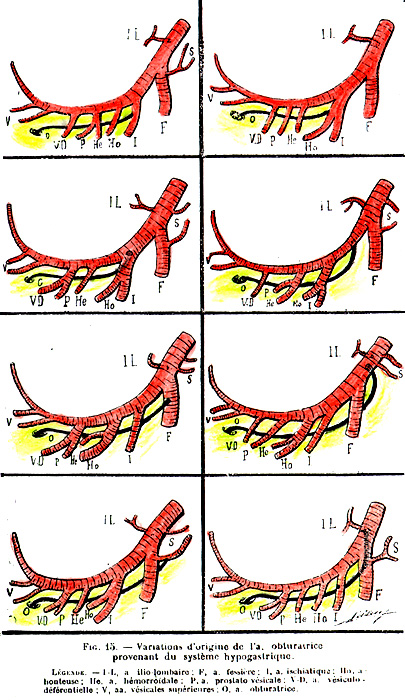
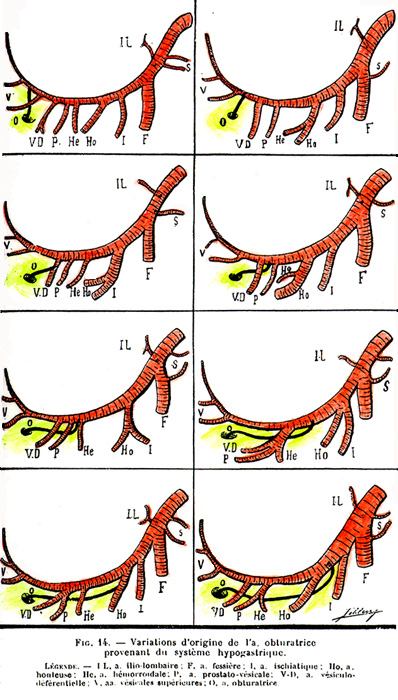
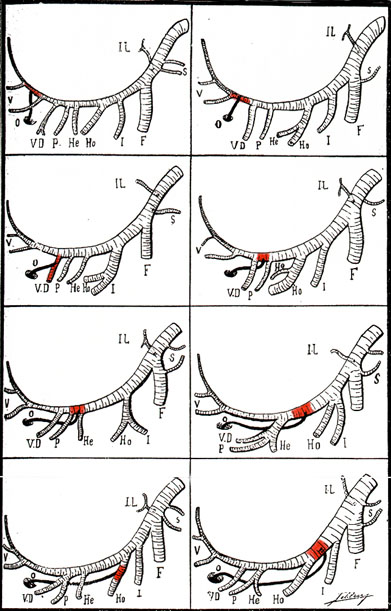
The obturator may arise from the common iliac, the anterior division of the internal iliac (41.4%), Ansons group found this origin in about 70% of individuals), inferior epigastric (25%), based on the Poynter table given above), superior gluteal (10%), inferior gluteal/internal pudendal trunk (10%), inferior gluteal (4.7%), internal pudendal (3.8%) or external iliac (1.1%).
The obturator artery may arise from both the hypogastric (internal iliac) and from the epigastric; this is commonly found (numerous 19th century authors including the present authors.).
The obturator has been found arising from the femoral artery adjacent to its profunda branch.
In only 23% of cases is a similar origin found on both sides of the body.
Anson says that one may expect an unusual obturator artery in about 48% of individuals.
The obturator artery gives rise to the ligamentun teres femoris artery in about 54% of subjects.
The obturator may have two roots, one arising as usual and the other from the external iliac.
Accessory obturators may be found.
Unusual branches of the obturator include: an iliolumbar, inferior vesical, uterine, vaginal, dorsal penis, ureteric, perineal, external pudendal, and inferior epigastric.
Its acetabular branch may be absent.
The epigastric artery may itself be absent and its distribution replaced by branches from the the profunda femoris. A condition where there is no connection between the intra and extra pelvic portions of the artery has been reported by several authors.
The obturator artery was reported 55 times in a review of the Committee of Collective Investigation of the Anatomical Society of Great Britian and Ireland (Parsons, F.G. and A. Keith). In 20 cases (36.4%) it arose as a separate trunk from the anterior division; in 10 (18.1%) from the inferior epigastric (deep epigastric); in 9 (16.4%) separately from the hypogastric trunk; in 8 (14.5%) from the posterior division, in 5 (9.1%) from the internal iliac before its division; while in 3 (5.4%) it arose in common with the middle rectal (middle hemorrhoidal), 2 of these coming from the anterior division, and one from the hypogastric trunk (Internal Iliac). Parsons and Keith reported that the origin of the obturator from the inferior epigastric; of 138 subjects examined at Guy's Hospital the obturator was seen to arise from the inferior epigastric only 11 times (8%); Quain's Anatomy, 10th ed. gives a value of nearly 30%. Parsons and Keith state in their report that the percentage was 18.1%. Although we do not have any statistics, the authors of this present book believe that a value closer to that of Quain's Anatomy may be closer to the true value based on our observations over 40 years. Additional observations are obviously needed.
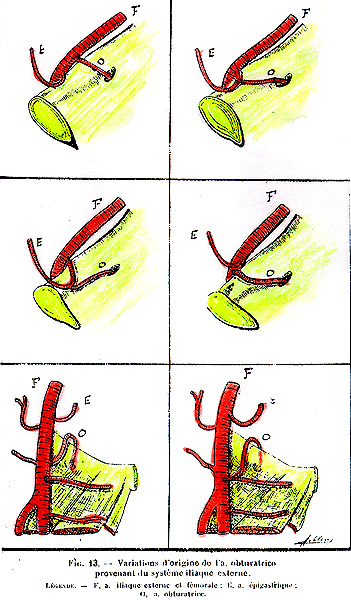
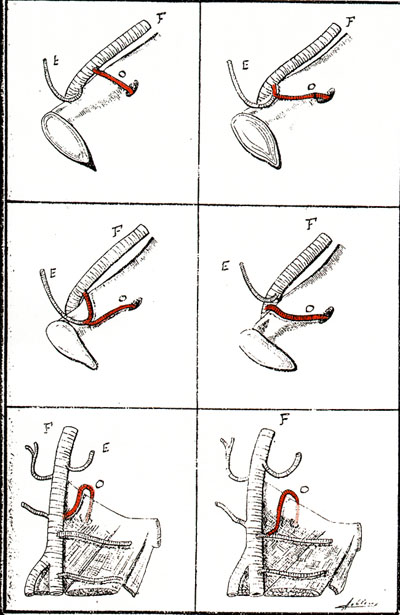
In 1836, Reid reported that, "the obturator artery runs a greater risk of being wounded during the operation for strangulated femoral hernia, than surgeons are inclined to admit; and if this be the case, the varieties in the origin and course of this artery deserve a fuller consideration than what is usually allotted...." The most common origin of the obturator artery is from the internal iliac or some of its branches; but in a great number of cases it is found to arise either directley, or much more commonly indirectly from the internal iliac, by a trunk common to it with the epigastric. When it arises from the internal iliac, it is evident that it can in no way be implicated in the operation for femoral hernia, in whatever manner it may be performed. Even when it arises from the external iliac, it is but very rarely endangered in the ordinary methods of performing this operation, as it generally proceeds downwards and inwards, first passing along the outer or iliac side of the femoral ring, and then along part of its posterior margin, to reach the upper portion of the obturator foramen. In rarer cases, which seem to be principally those in which the common trunk of the obturator and epigastric is longer than usual, the obturator takes a more circuitous course, passing along the upper margin of the femoral ring, and then along its inner or pubic margin. It must be evident that when a femoral hernia descends, the relative position of the artery to the neck of the sac, in these two cases, is very different, and, in a practical point of view, involves very important considerations.
Reid points out, that the most common, or what is considered the normal origin of this artery, is from the internal iliac, or one of its branches. The origin next in frequency is by a common trunk with the epigastric from the external iliac. More rarely it springs directly from the external iliac, and still more rarely from the femoral. Though the artery may thus arise from points placed at a considerable distance from each other, it invariably makes its way out of the pelvis by the same opening, viz. the upper part of the obturator foramen. When it is a branch of the femoral it passes upwards along that artery, passes below Pouparts's ligament (injuinal) and places itself in the same position as if it had arisen within the abdomen.
Reid cites Cloquet who examined 250 subjects; 125 females and 125 males, for the purpose of ascertaining the relative frequency of the origin of the obturator, from the hypogastric (internal iliac), external iliac, and the epigastric. In these the obturator arose from the hypogastric (internal iliac) in both sides in 160; from the epigastric on both sides in 56; from the epigastric on one side, and the hypogastric (internal iliac) on the othere, in 28; from the external iliac in 6. Including both sides of the body, thus increasing the number of arteries examined to 500, and taking all the obturator arteries which arose from the hypogastric (internal iliac) arteries, and all those which arose from the epigastric arteries, or directly from the external iliac, he found that the obturator arose from the hypogastric in 348; from the epigastric or external iliac in 152. According to these results, the frequency of the origin of the obturator artery from the hypogastric (internal iliac) are to those from the epigastric and external iliac as 3 to 1. The obturator was found to arise rather more frequently from the hypogastric (internal iliac) in males than in females. Monro, cited by Reid, thought the relative proportion between the origin of the obturator artery from the internal iliac and its branches, and from the epigastric and the external iliac, to be as 20 to1. Velpeau, also cited by Reid, stated that his observations, drawn from the examination of nearly a thousand cases, led him to coincide in Monro's opinion. According to Reid, Hesslbach thought that the origin of the obturator from from the external iliac and epigastric is not very common, and strangely asserts, that it rarely occurs except in females. Further, Manec stated the proportion to be 1 in 6; Scarpa and Lawrence as 1 in 15. Citing other research, the obturator was found to arise in common with the epigastric in 12 out of 63 subjects, affected with crural hernia, and in all passed behind the neck of the sac. Meckel was of the opinion that the obturator arises nearly as frequently from the the epigastric and external iliac, as from the internal iliac and its branches. Reid concluded his paper by stating that his conclusions from his dissections coincide most closely with those of Cloquet.
Origins of Obturator Artery, from Braithwaite.
Origin
Female # / %
Male # / %
Total # / %
A. From Interal Iliac Artery:
Direct branch from anterior division
24 / 39.3
46 / 46.2
70 / 41.4.
Inferior gluteal-internal pudendal trunk
5 / 8.2
12 / 11.1
17 / 10.0.
Inferior gluteal artery
2 / 3.2
6 / 5.5
8 / 4.7.
Internal pudendal artery
2 / 3.2
4 / 3.7
6 / 3.8.
Superior gluteal artery
10 / 16.4
7 / 6.4
17 / 10.0.
Iliolumbar artery
3 / 4.9
2 / 1.8
5 / 3.5.
B. From External Iliac Artery
Direct branch
1 / 1.6
1 / 0.9
2 / 1.1.
Inferior epigastric artery
10 / 16. 4
23 / 21.3
33 / 19.5.
C. From Internal and External Iliac Arteries:
By double origin
4 / 6.4
7 / 6.4
11 / 6.5.
Totals:
61 / 99.6
108 / 99.7
169 / 99.5.
See also inferior epigastric artery below.
The Variation of the Obturator Artery Arising from the External Iliac Artery; Frequency According to Gender Males Females # Cases % # Cases %
Quain
181
29.8
180
33.9
Cloquet
250
24.4
250
31.4
Schlobig
74
28.4
38
34.2
Krusche
63
25.9
16
37.5
Jastschinski
572
26.3
462
34.6
Pfitzner
163
38.3
39
35.6
Totals
1,303
26.9
985
35.3
From Dubreuil-Chambardel, 1925
The Variation of the Obturator Artery Arising from the External Iliac Artery; Frequency According to Side Bilateral Unilateral # Cases Studied Right Left
Meckel ? 1 10
Cloquet 250 62 28
Quain 159 25 18 38 20
Hesselbach 32 12 15
Pfitzner 105 35 36
Schlobig ? 22 12
Dubreuil-Chambardel 130 41 27 49 22
---------------------------------------------------------------------------------------------------------------------------
Uni-/Bilateral Side Totals 539 128 115
---------------------------------------------------------------------------------------------------------------------------
Unilateral Side, (R/L) Totals 426 92 93
From Dubreuil-Chambardel
Sources of the Obturator Artery
Author(s) # cases Obturator from Internal Iliac Obturator from External Iliac # cases % # cases %
Cloquet (Paris)
500
348
69.6
152
30.4
Hoffmann (Bale)
400
270
67.5
130
32.5
Quain (London)
361
246
68.6
115
31.4
Pfitzner (Strasbourg)
226
141
62.4
85
37
Hartmann (Berlin)
180
146
81
34
19
Schlöbig (Leipzig)
112
78
69.6
34
21
Krusche (Dorpat)
80
63
78.8
17
20
Hesselbach (Wurzburg)
64
37
57.7
27
43.3
Breschet (Paris)
63
51
81
12
19
Wyeth/Warwell (London)
52
34
66
18
34
Dwight (America)
500
371
74.2
129
25.8
Jastschinski (Varsovic)
1034
723
70
311
30
Levi (Florence)
110
82
74.8
28
25.2
Dubreuil-Chambardel (Paris)
440
310
70.5
130
29.5
Totals %
4122
2900
70.84%
1222
28.4
From Dubreuil-Chambardel, 1925.
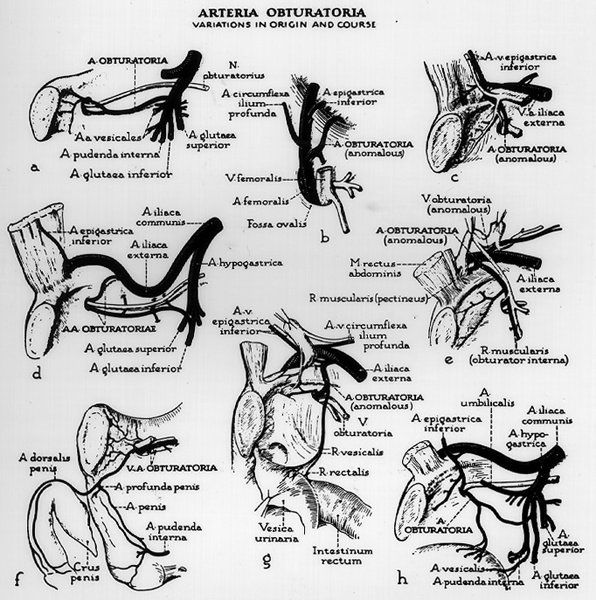
Hypogastric (Internal Iliac) Trunk
Anatomy Atlases. Immagine ospitata dal sito d’origine. Apri la pagina originale.
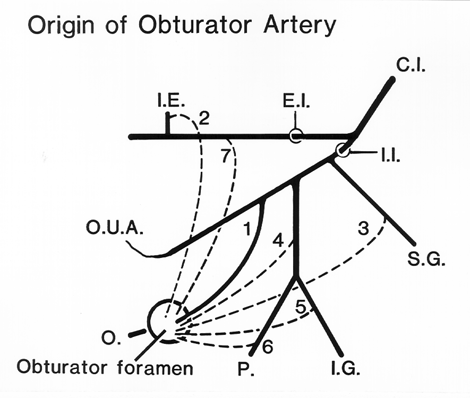
Hypogastric (Internal Iliac) Trunk
Anatomy Atlases. Immagine ospitata dal sito d’origine. Apri la pagina originale.
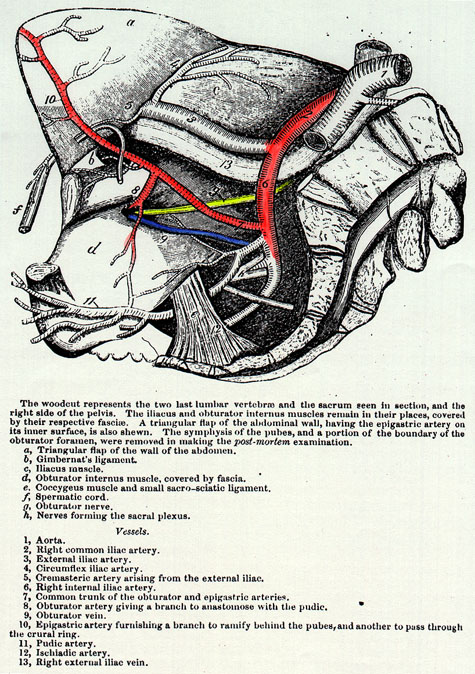
Hypogastric (Internal Iliac) Trunk
Anatomy Atlases. Immagine ospitata dal sito d’origine. Apri la pagina originale.
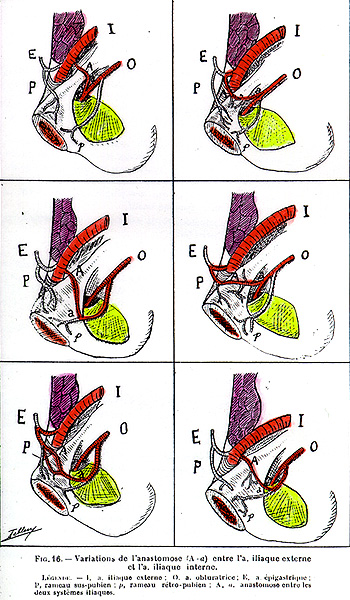
Hypogastric (Internal Iliac) Trunk
Anatomy Atlases. Immagine ospitata dal sito d’origine. Apri la pagina originale.
Hypogastric (Internal Iliac) Trunk
Anatomy Atlases. Immagine ospitata dal sito d’origine. Apri la pagina originale.
Hypogastric (Internal Iliac) Trunk
Anatomy Atlases. Immagine ospitata dal sito d’origine. Apri la pagina originale.
Hypogastric (Internal Iliac) Trunk
Anatomy Atlases. Immagine ospitata dal sito d’origine. Apri la pagina originale.
Hypogastric (Internal Iliac) Trunk
Anatomy Atlases. Immagine ospitata dal sito d’origine. Apri la pagina originale.
Hypogastric (Internal Iliac) Trunk
Anatomy Atlases. Immagine ospitata dal sito d’origine. Apri la pagina originale.
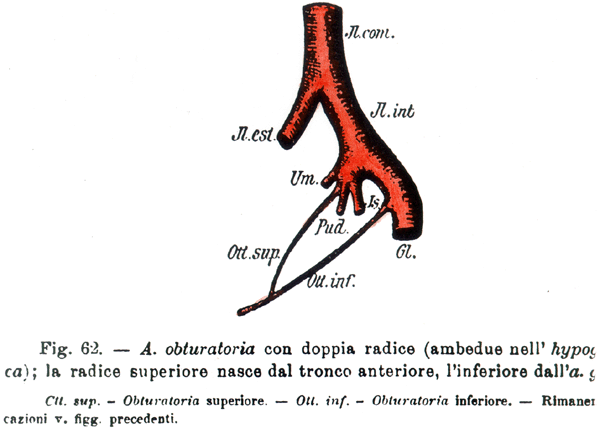
Hypogastric (Internal Iliac) Trunk
Anatomy Atlases. Immagine ospitata dal sito d’origine. Apri la pagina originale.
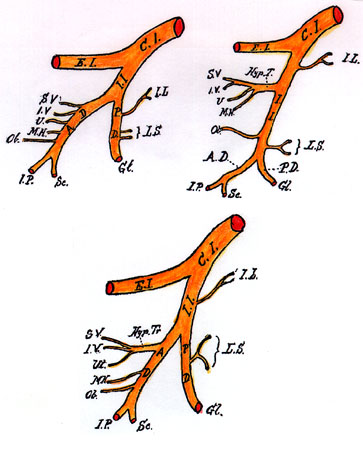
Anatomy Atlases. Immagine ospitata dal sito d’origine. Apri la pagina originale.
Riferimenti dell’opera originale
Elenco riportato come compare nella fonte, senza normalizzazione dei formati bibliografici.
- Bard, -. (1875) Statistique sur l'artère obturatrice. Lyon Méd. 19:218.
- Batteur, M. (1951) Un cas exceptionel de variation de l'artère obturatrice. Assoc. Anatomistes, Comptes Rendus 38:116.
- Bergman, R.A., Thompson, S.A., Afifi, A.K. and F.A. Saadeh. (1988) Compendium of Human Anatomic Variation: Catalog, Atlas and World Literature. Urban & Schwarzenberg., Baltimore and Munich.
- Braithwaite, J.L. Variations in origin of the parietal branches of the internal iliac artery. J. Anat. 86:423-430, 1952.
- Broca, -. (1849) Cinq anomalies artèrielles sur le même sujet. - Anomalie rare des artères de l'avant-bras. Bull. et Mém. de la Soc. Anatomique de Paris 1849:49-59.
- Carrier, R.E. 0 880) Peculiarities in the origin and course of arteries of upper eHtremities. Toledo Medical and Surgical Journal 4:365-367.
- Chandler, S.B. and P.H. Kreuscher (1932) A study of the blood supply of the ligamentum teres and its relation to the circulation of the head of the femur. J. Bone Joint Surg. 14:834-846.
- Cordier, G. and C. Cabrol. (1921) Deux variétés d'origine de l'artère obturatrice. Soc. Biol. Comptes Rendus Hebdomadaires des Seances et Memoires 84:896-897.
- Crock, H.V. (1965) A revision of the anatomy of the arteries supplying the upper end of of the human femur. J. Anat. 99:77-88.
- Curtis, A.H., Anson, B.J., Ashley, F.L. and T. Jones. (1942) The blood vessels of the female pelvis in relation to gynecological surgery. Surg., Gynecol. Obstet. 75:421-423.
- Delitzin, S. (1896) über eine complicierte Anomalie im Gebiete der Arteria obturatoria und epigastrica inferior. Arch. Anat. Physiol. Wissen. Med. 1896:413-422.
- Dschau, F. (1936-37) Eine bisher unbekannte Varietät der arteria obturatoria und pudenda accessoria mit einer Varietät der A. circumflexa femoris medialis. Anat. Anz. 83:25-29.
- Dubreuil-Chambardel, L. (1925) Traité des Variations du System Artériel Variations des Artères du Pelvis et du Membre Inferieur, Masson et Cie., Paris.
- Duclaux, H. (1902) Anomalies de l'épigastrique et de l'obturatrice. Bull. et Mém. de la Soc. Anatomique de Paris 4:58-59.
- Howe,Jr., W.W., Lacey, T. and R.P. Schwartz. (1950) A study of the gross anatomy of the arteries supplying the proximal portion of the femur and the acetabulum. J. Bone Joint Surg. 32A:856-866.
- Jastschinski, S. (1891) Die Abweichungen der Arteria obturatoria nebst Erklärung ihres Entstehens. International Monatsschrift für Anatomie und Physiologie 8:367-386.
- Lipshutz, B. (1918) A composite study of the hypogastric artery and its branches. Ann. Surg. 67:584-608.
- Pác, L., Hamplová, M. and O. Pelcová. (1977) An atypical case of arising of some parietal branches of the arteria iliaca interna in man. Anat. Anz. 141:450-454.
- Parsons, F.G. and A. Keith (1897) Sixth annual report of the Committee of Collective Investigation of the Anatomical Society of Great Britain and Ireland, 1895-96. J. Anat. Physiol., London 31:31-44.
- Pfitzner, W. (1889) über die Ursprungsverhältnisse der Arteria obturatoria. Anat. Anz. 4:504-514.
- Pick, J.W., Anson, B.J. and F.L. Ashley (1942) The origin of the obturator artery. A study of 640 body-halves. Am. J. Anat. 70:317-344.
- Poynter, C.W.M. (1922) Congenital anomalies of the arteries and vein of the human body with bibliography. University Studies of the University of Nebraska. 22:1-106.
- Ramsay, A. (1813) Account of unusual conformation of some muscles and vessels. Edinburgh Medical and Surgical Journal 8:281-283.
- Redfern, P. (1850) Origin of the epigastric and obturator arteries by a common trunk from the internal iliac; with a inquiry into the amount of danger occasioned by various positions of arteries in the ordinary operations for femoral and inguinal herniae. Monthly Journal of Medicine, Edinburgh 9:203-222
- Reid, J. (1836) On the varieties of the obturator artery, and the relation of these to the femoral ring. Edinburgh Medical and Surgical Journal 45:65-70.
- Rochard, E. (1887) Anomalie de rapports de l'artère obturatrice. Bull. et Mem. de la Soc. Anatomique de Paris 1887:145-148.
- Sonje PD, Vatsalaswamy P. Study of Variations in the Origin of Obturator Artery. Indian J Vasc Endovasc Surg 2016;3:131-5
- Tuffier, -. (1888) Note sur deux cas d'anomalies de l'obturatrice. Bull. et Mem. de la Soc. Anatomique de Paris 1888:50-52.
- Tuloup, -. (1874) Origin de l'artère obturatrice a l'épigastrique. Lyon Méd. 15:498.
- Walsham, W.J. (1880) The deep epigastric given off by the obturator. St. Bartholomews Hospital Reports 16:92.
- Winslow, R. (1883) A study of the malformations, variations, and anomalies of the circulatory apparatus in man. Annals of Anatomy and Surgery 7:146-148.
- Wyeth, J.A. and W.L. Wardwell. (1877) Notes upon the surgical anatomy of the obturator artery. The difference of its relations in the male and female, with a consideration of its importance in the operation for relief of femoral hernia. The medical Record. 12:630-631.
Classificazione anatomica
- Sistemi:
- Sistema cardiovascolare
Provenienza del contenuto
Adattamento
Adattamento di «Obturator Artery — Illustrated Encyclopedia of Human Anatomic Variation: Opus I: Muscular System» di Ronald A. Bergman, Adel K. Afifi, Ryosuke Miyauchi. Fonte: https://www.anatomyatlases.org/AnatomicVariants/Cardiovascular/Text/Arteries/Obturator.shtml Opera originale distribuita con licenza CC BY-NC-SA 4.0 (https://creativecommons.org/licenses/by-nc-sa/4.0/deed.it). Adattamento a cura di Redazione AIVA. Modifiche rispetto all’originale: Testo originale inglese riprodotto integralmente e riorganizzato nel formato scheda del portale (sintesi, testo, riferimenti), senza modificarne le affermazioni. La traduzione italiana non è ancora stata eseguita, e la pagina lo dichiara. Le figure non sono state copiate: sono collegate alla pagina d’origine. Questa pubblicazione non è approvata né avallata dagli autori dell’opera originale.
Licenza
Questo contenuto è distribuito con licenza CC BY-NC-SA 4.0. Licenze e attribuzioni