Voce enciclopedica
Orbicularis Oculi, Corrugator Supercilii (Henle), Procerus
Abstract
These muscles vary in their differentiation and extent and may be fused with other muscles in the region. The two orbicularis oculi muscles may be united by a transverse glabellae muscle. An upward extension of the platysma has been seen to reach the lower eyelid. The palpebral and orbital portions of these muscles may be completely separate. The orbital portion of orbicularis oculi may be absent, and a rudimentary palpebral portion of the same muscle has been reported. A musculus laryrmalis, associated with the medial side of orbicularis oculi, has been described.
These muscles vary in their differentiation and extent and may be fused with other muscles in the region. The two orbicularis oculi muscles may be united by a transverse glabellae muscle. An upward extension of the platysma has been seen to reach the lower eyelid. The palpebral and orbital portions of these muscles may be completely separate. The orbital portion of orbicularis oculi may be absent, and a rudimentary palpebral portion of the same muscle has been reported. A musculus laryrmalis, associated with the medial side of orbicularis oculi, has been described.
The absence of the orbital portion of corrugator has also been reported.
Procerus may be absent on one or both sides, and may be better developed on one or both sides. The attachments vary considerably. Although considered a distinct muscular unit , it is rarely clearly separated from frontalis. The two muscles may be continuous over the bridge of the nose.
Syn.: (Orb. Oc.) m. lacrymalis s. Thränenmuskel s. Horneri s. Rosenmülleri s. tensor tarsi s. sacci lacrymalis, orbicularis palpebrae s. sphincter palpebrae; (Pro.) pyramidalis nasi.
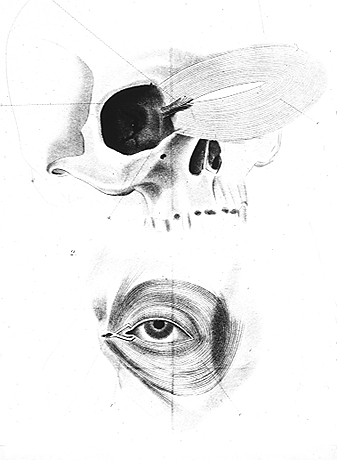
a. saccus lacrymalis; b. os lacrymale; c. musculus lacrymalis; d. m. corrugator supercilii; e. m. orbicularis orbitae; f. canaliculi lacrymales; m. depressor supercilii.
from Lesshaft. — Anatomy Atlases. Immagine ospitata dal sito d’origine. Apri la pagina originale.
Riferimenti dell’opera originale
Elenco riportato come compare nella fonte, senza normalizzazione dei formati bibliografici.
- Anson, B.J., Ed. (1966) Morris' Human Anatomy, 12th ed., The Blakiston Division, The McGraw-Hill Book Company, New York.
- Henle, J. (1871) Handbuch der Muskellehre des Menschen, in Handbuch der systematischen Anatomie des Menschen. Verlag von Friedrich Vieweg und Sohn, Braunschweig.
- Lesshaft, P. (1868) Ueber den Musculus orbicularis orbitae und seinen Einfluss auf den Mechanismus der Thranenabsonderung. Arch. Anat. Physiol. Wissen. Med. 1868:265-301.
Classificazione anatomica
- Sistemi:
- Sistema muscolare
Provenienza del contenuto
Adattamento
Adattamento di «Orbicularis Oculi, Corrugator Supercilii (Henle), Procerus — Illustrated Encyclopedia of Human Anatomic Variation: Opus I: Muscular System» di Ronald A. Bergman, Adel K. Afifi, Ryosuke Miyauchi. Fonte: https://www.anatomyatlases.org/AnatomicVariants/MuscularSystem/Text/O/19Orbicularis.shtml Opera originale distribuita con licenza CC BY-NC-SA 4.0 (https://creativecommons.org/licenses/by-nc-sa/4.0/deed.it). Adattamento a cura di Redazione AIVA. Modifiche rispetto all’originale: Testo originale inglese riprodotto integralmente e riorganizzato nel formato scheda del portale (sintesi, testo, riferimenti), senza modificarne le affermazioni. La traduzione italiana non è ancora stata eseguita, e la pagina lo dichiara. Le figure non sono state copiate: sono collegate alla pagina d’origine. Questa pubblicazione non è approvata né avallata dagli autori dell’opera originale.
Licenza
Questo contenuto è distribuito con licenza CC BY-NC-SA 4.0. Licenze e attribuzioni