Voce enciclopedica
Pyramidalis
Abstract
The first anatomist to refer to the pyramidalis was Nocolai Massa (1538) who assumed that this muscle assisted in the erection of the penis while Vesalius (1543) thought that it had the function of expressing urine from the penis, "pene urieversum efformans musculum". Riolan (1649) noted that the muscle is occasionally absent, as did Crooke (1650), and Rolfinck (1656). Rolfinck also noted that occasionally only one of the two muscles was present, almost invariably on the right side. Diemerbroek (1672) repeated these observations Ruysch (1704) reported that on one side the muscle was doubled.
The first anatomist to refer to the pyramidalis was Nocolai Massa (1538) who assumed that this muscle assisted in the erection of the penis while Vesalius (1543) thought that it had the function of expressing urine from the penis, "pene urieversum efformans musculum". Riolan (1649) noted that the muscle is occasionally absent, as did Crooke (1650), and Rolfinck (1656). Rolfinck also noted that occasionally only one of the two muscles was present, almost invariably on the right side. Diemerbroek (1672) repeated these observations Ruysch (1704) reported that on one side the muscle was doubled. A similar description of three pyramidales was cited by Winslow (1749). Additional reports of variations in this muscle were given by Verheyen (1706), Santorini (1724), Hammer (1765), Sabatier (1781) (who described the presence of two pyramidales on each side, or four in each body) and Lieutaud (1782). Horner (1826) reported three and sometimes four muscles on each side and Hallett (1848) said he saw two pyramidales on each side in several cases. The muscle is a constant feature of man and other primates and may be related to the assumption of the upright posture in man. Vallois (1926) referred to this association in humans. An expanded version of this history can be found in the article by Ashley-Montague, (1939).
This muscle varies greatly in length (20-138mm) and size. It is often absent on one or both sides, in which case the size of the lower part of the rectus is often increased. It is rarely symmetrical bilaterally. It is absent in about 8% of all individuals studied, more frequently in males and more often on the right side. The muscle is present in ~82% of the white population, ~90% of Blacks, ~95% of Japanese, and ~"always" present in Chinese. Loth's data, combined with that of Mori, give us the following table:
Population
Authors
Observations
%Present
French
Ancel (1902)
146
71
French
LeDouble (1897
243
89
Berber
Leblanc, Curtillet (1930)
43
72
English
Thomson (1897)
270
74
Irish
Knott (18)
160
76
Japanese
Mori (1964)
567
94.5
American
Dwight (1895)
673
79
Polish
Loth (1924)
200
79
Alsatian
Schwalbe, Pfitzner (1894)
393
87
Chinese
Nakano (1923)
23
100
Chinese
Wagenseil (1927)
80
99
Black
Loth (1912), streblow (1915)
105
87
Black
Vallois (1926)
2266
82
In some instances, the muscle has been found doubled and may extend upward as far as the umbilicus. It is usually supplied by the subcostal nerve (T12) and occasionally by the iliohypogastric (L1).
The pyramidalis muscle is supplied by the muscular branches of the inferior epigastric artery and veins.
Syn.: m. pyramidalis abdominis.
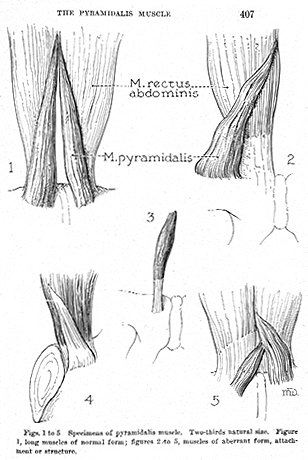
Varieties of Pyramidalis.
from Anson, Beaton, and McVay. — Anatomy Atlases. Immagine ospitata dal sito d’origine. Apri la pagina originale.
Riferimenti dell’opera originale
Elenco riportato come compare nella fonte, senza normalizzazione dei formati bibliografici.
- Adachi, B. (1910) Beitrage zur Anatomie der Japaner. XII. Die Statistik der Muskelvarietäten. Z. Morph. & Anthrop.12:261-312.
- Ancel, P. (1901-02) Documents receuillies à la salle de dissection de la Fac. de Médecine de Nancy. Bibliographie Anatomique, IX & X:133-160.
- Ando, T. (1938) On the rectus abdominis and the pyramidalis. Sotai taijino kaibogakuteki kenkyu. 2:1-30. In Japanese.
- Anson, B.J., Beaton, L.E. and C.B. McVay. (1938) The pyramidalis muscle. Anat. Rec. 72:405-411.
- Ashley-Montagu, M.F. (1939) Anthropological significance of the musculus pyramidalis and its variability in man. Am. J. Phy. Anthropol. 25:435-490.
- Beaton, L.E. and B.J. Anson. (1939) The pyramidalis muscle: Its occurrence and size in American Whites and Negroes. Am. J. Phys. Anthropol. 25:261-269.
- Bryce, T.H. (1923) Myology. Quain's Elements of Anatomy, Longmans, Green and Co., London.
- Crooke, H. (1650) Myographia. London.
- Cruvielheir, J. (1880) Traité d'Anatomie descriptive. II, Paris. van Diemerbroek, I. (1672) Anatome corporis humani. Ultrajecti.
- Dwight, T. (1893) Observations on the psoas parvus and pyramidalis. A study on variation. Proc. Am. Phil. Soc. 31:117-123.
- Fallopius, G. (1562) Observationes Anatomicae. Venetiis. Gegenbaur, C. (1895) Lehrbuch der Anatomie des Menschen. Leipzig.
- Hallett, C.H. (1848) An account of the anomalies of the muscular system, met with in the dissecting-room of the University during the years 1846-47; with general remarks. Edinburg. Med. Surg. J. 69:1-32.
- Hallett, C.H. (1849) An account of the anomalies of the muscular system, met with in the dissecting room of the University during the years 1847-1848; with general remarkes. Edinburg. Med. Surg. J. 70:1-20.
- Hammer, W.C. (1765) De musculorum Varietate. Dissertation, Erlangen.
- Henle, J. (1871) Handbuch der Muskellehre des Menschen, in Handbuch der systematischen Anatomie. Verlag von Friedrich Vieweg und Sohn, Braunschweig.
- Hibi, M. (1931) Über den M. pyramidalis bei den Hokuriku-Japanern, Kanazawa Kaibô. Gyoseki 9:18-19.
- Igarashi, N. and M. Hoshiba. (1936) The M. pyramidalis. Kanazawa Ikadaigaku Kaibogakukyoshitsu Gyosekishu 22:62-79. In Japanese.
- Kaneno, T. and K. Wajima. (1955) A study on the M. rectus abdominis. Nihon Daigaku Zasshi 14:1511-1525. In Japanese.
- Kawaai, M. (1936) On the M. pyramidalis, especially in its area, of adults and fetus. Kaibogaku Zasshi 9:182-197. In Japanese.
- Knott, J.F. (1881) Muscular anomalies. Proc. Roy. Irish Acad. Sci. Ser. 2, 3:627-641.
- Knott, J.F. (1881), Horner, W.E. (1826) A Treatise on Special and General Anatomy. Philadelphia. Muscular anomalies. Proc. Roy. Irish Acad. Sci. Ser. 2, 3:627-641.
- Koganei, -., Arai, -. and -. Shiknami . (1903) Statistik der Muskelvarietäten. Mitt. Mediz. Ges., Tokio 17:123-131.
- LeDouble, A.F. (1897) Traité des Variations du Système Musculaire de l'Homme et Leur Signification au Point de vue de l'Anthropologie Zoologique. Libraire C. Reinwald, Scheicher Freres, Paris.
- Lieutaud, J. (1782) Zergleiderungskunst, nach der neuesten mit ... Bemerkungen von Hrn. Portal; vermehrten Ausgäbe, übersetzt. Leipzig.
- Loth, E. (1912) Beiträge zur Anthropologie die Negerweichteile (Muskelsystem). Stuttgart. 98-99.
- Loth, E. (1919) Anthropmorphfologia des Muscles. Bull. Mém. Soc. Anthrop. Paris. 10:116-133.
- Loth, E. (1921) Antropomorfologia miésni. Arch. Nauk. Antropologicznich (Warsaw) 1:129-134.
- Loth, E. (1931) Anthropolgie des parties molles. Paris. 143-147. von Luschka, H. (1870) Der M. pubotransversalis des Menschen. Arch. Anat. Physiol. Wissen. Med. 1870:227-231.
- Macalister, A. (1875) Observations on muscular anomalies in the human anatomy. Third series with a catalogue of the principal anomalies hitherto published. Trans. Roy. Irish Acad. Sci. 25:1-130.
- Massa, N. (1536) Liber introductorius Anatomiae, sive dissectionis corporis humani. Venetiis. Cap.21:37-38.
- Meckel, J.F. (1828) System der vergleichenden Anatomie. Halle. 3:392-670.
- Mori, M. (1964) Statistics on the musculature of the Japanese. Okajimas' Fol. Anat. Jap. 40:195-300.
- Morita, M. (1940) On the M. pyramidalis of man and mammals. Igaku Kenkyu 14:151-157. In Japanese.
- Morita, M. (1947) On the M. rectus abdominis, appendix, the length of the M. pyramidalis. Kaibogaku Zasshi 23:50-55. In Japanese.
- Nakamura, S. (1935) Ueber den M. rectus abdominis und den M. pyramidalis der Japaner (aus Kyushu). J. Kumamoto Med. Soc. 11:1251-1261)
- Nakano, T. (1923) Beiträge zue Anatomie die Chinesen. Die Statistik des Muskelvarietäten.Okajimas' Folia Anat. Jap. (Tokyo) 1:273-282.
- Obata, T. and A. Sugiyama. (1943) The M. rectus abdominis and M. pyramidalis. Sotaitaiji no Kaibogakuteki Kenkyu 4:155-185. In Japanese.
- Riolan, J. (1626) Anthropographia et Osteologia. Cap. 33:501. Paris.
- Riolan (Filii), J. (1649) Opera Anatomica. Paris. 83.
- Rolfinck, W. (1656) Dissertationes Anatomicae. Noribergae, 579-580.
- Ruysch, F. (1704) Thesaurus Anatomicus quartus. 37, no. 83.
- Sabatier, R.B. (1781) Traité complet d'Anatomie. Paris. 1:262-264.
- Santorini, G.D. (1724) Observationes Anatomicae. Venetiis. Cap. 9:160.
- Schaefer, E.A., Symington, J. and T.H. Bryce., Eds. (1923) Quain's Elements of Human Anatomy, 11th ed. Longmans, Green and Co., London.
- Schwalbe, G. and W. Pffitzner. (1889) Variet Statistik und Anthropologie. Anat. Anz. 4:705-714.
- Schwalbe, G. and W. Pfitzner. (1891) Varietaten Statistik und Anthropologie. Anat. Anz. 6:573-590.
- Schwalbe, G. and W. Pfitzner. (1893-94) Morphologische Arbeiten. Jena 3:459-490.
- Smith, E.Barclay (1895) Fifth annual report of the committee of collective investigation of the Anatomical Society of Great Britain and Ireland for the year 1893-94. J. Anat. Physiol. 9:35-60.
- Spigel, A. (1627) De corporis humani fabrica. Venetiis.
- Testut, L. (1884) Les anomalies musculaires chez les Negros et chez les Blancs. Internat. Monatschrift Anat. et Histol. 1:285-291.
- Tomita, A. (1937-39) Study on the pyramidalis. Kyushu Igakusenmongakko Igakkai Zasshi 2:43-58. In Japanese.
- Vallois, H.V. (1925a) Recherches d'anatomie comparee sur le muscle pyramidal. L'Assoc Anatomistes, Comptes Rendus. Turin pp. 367-370.
- Vallois, H.V. (1925b) La signification des variations musculaires dans les races humaines. Rev. Anthrop. 35:11-24.
- Vallois, H.V. (1926) Valeur et signification du muscle pyramidal de l'abdomen. Arch. Anat., Histol. & Embryol. 5:497-525.
- Verheyen, P. (1706) Corporis Humani Anatomia. Lipsiae. pp. 59-60.
- Wagenseil, F. (1927) Muskelbefunde bei Chinesen. Verh. Ges. Phys. Anthrop. (Stuttgart) 2:42-50.
- Warfe., J.H., JR. (1985) The Head, Neck, and Trunk, 5th ed. Lea & Fibiger, Philadelphia.
- Weidersheim, R. (1908) Der Bau des Menschen. T. pp. 133-134.
- Winslow, J.B. (1749) An Anatomical Exposition of the Structure of the Human Body. London. I, p.168.
Classificazione anatomica
- Sistemi:
- Sistema muscolare
Provenienza del contenuto
Adattamento
Adattamento di «Pyramidalis — Illustrated Encyclopedia of Human Anatomic Variation: Opus I: Muscular System» di Ronald A. Bergman, Adel K. Afifi, Ryosuke Miyauchi. Fonte: https://www.anatomyatlases.org/AnatomicVariants/MuscularSystem/Text/P/49Pyramidalis.shtml Opera originale distribuita con licenza CC BY-NC-SA 4.0 (https://creativecommons.org/licenses/by-nc-sa/4.0/deed.it). Adattamento a cura di Redazione AIVA. Modifiche rispetto all’originale: Testo originale inglese riprodotto integralmente e riorganizzato nel formato scheda del portale (sintesi, testo, riferimenti), senza modificarne le affermazioni. La traduzione italiana non è ancora stata eseguita, e la pagina lo dichiara. Le figure non sono state copiate: sono collegate alla pagina d’origine. Questa pubblicazione non è approvata né avallata dagli autori dell’opera originale.
Licenza
Questo contenuto è distribuito con licenza CC BY-NC-SA 4.0. Licenze e attribuzioni